

Leadership Fatigue

Navigating the Labyrinth: Battling Leadership Fatigue Among India’s CXOs

You are currently viewing Navigating the Labyrinth: Battling Leadership Fatigue Among India’s CXOs

Navigating the Labyrinth: Battling Leadership Fatigue Among India’s CXOs

India’s business leaders are operating in one of the most demanding leadership environments in the world. The pace is relentless. Markets shift quickly, technology disrupts familiar models, stakeholders expect constant growth and every decision seems to carry consequences far beyond the boardroom.

For many CXOs, this pressure does not always appear as a dramatic breakdown. It often begins quietly: a shorter temper, slower decisions, reduced enthusiasm, restless sleep, or a growing sense of emotional distance from work that once felt meaningful. This is leadership fatigue.


Leadership fatigue is more than ordinary stress. It is the deep mental, emotional and physical depletion that builds when leaders remain in high-responsibility roles without adequate recovery, reflection, or support. Unlike general burnout, it is shaped by the unique burden of being “at the helm”, where every choice affects people, performance, culture and the future of the organization.

For Indian business leaders, the challenge is especially complex. Rapid economic growth, intense competition, family and social expectations and the pressure to blend Indian values with global business practices can create a leadership environment that is both exciting and exhausting.

As a leadership coach and trainer, Dr. Mathew Thomas works with leaders who understand that resilience is not a soft skill. It is a strategic necessity.

The Unseen Toll: Symptoms of Leadership Fatigue

Leadership fatigue does not always announce itself loudly. Often, it hides behind competence. A CXO may continue attending meetings, reviewing dashboards, approving budgets and leading teams while quietly running on empty.

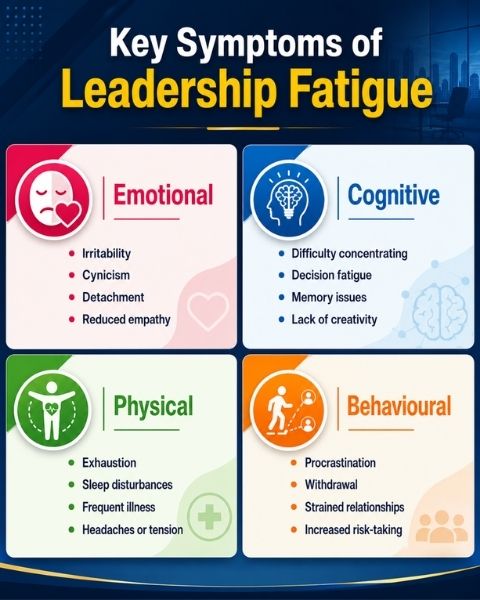
The symptoms often appear in four areas.

Executive Burnout India

Emotionally,
leaders may feel irritable, cynical, detached, or unusually impatient. A leader
who once listened deeply may begin rushing conversations. A CEO who previously
inspired confidence may start reacting sharply to minor setbacks. Reduced
empathy is one of the most overlooked signs of executive burnout.

Cognitively, leadership fatigue can show up as decision fatigue, poor concentration, memory lapses, or loss of creativity. The CXO who once saw possibilities may begin seeing only problems. Strategic thinking narrows. Every decision feels heavier than it should.
Physically, the body begins to carry the cost. Exhaustion, sleep disturbances, headaches, digestive issues and frequent illness may become normalised. Many Indian CXOs push through these signals, believing that stamina is part of leadership. But ignoring the body’s warnings rarely leads to better performance.

Behaviourally, fatigue may lead to procrastination, withdrawal, strained relationships, increased risk-taking, or over-control. A leader may stop delegating because they no longer trust others to “get it right”, or they may avoid difficult conversations because they no longer have the emotional bandwidth.

In India’s high-performance business culture, these symptoms are often misread as temporary pressure. But when they persist, they become a serious leadership risk.

Roots of the Strain: Why Indian CXOs Are Feeling the Pressure

stress management for leaders


Leadership fatigue among Indian CXOs is not caused by one factor. It is usually the result of many pressures converging at once.

One major contributor is the speed of market change. Digital disruption, artificial intelligence, changing consumer behaviour, new competitors and evolving business models require leaders to constantly adapt. What worked five years ago may not work today.

Then there is the pressure for perpetual growth. Boards, investors, customers, employees and markets expect strong performance quarter after quarter. For many CXOs, success does not reduce pressure; it increases it.
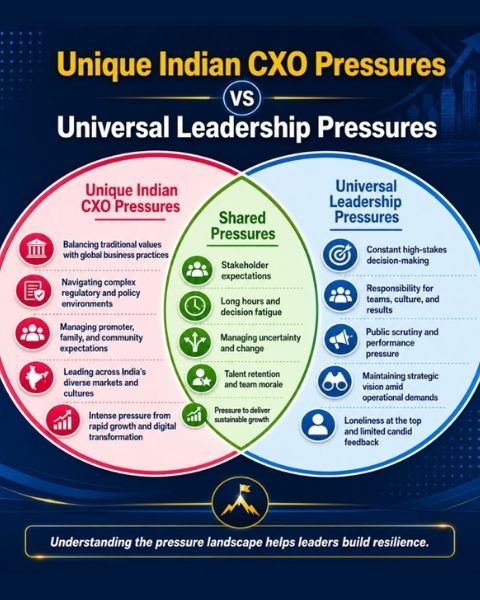
The Indian context adds its own complexity. Leaders often balance traditional values with global business practices. They may need to honour hierarchy while encouraging agility, preserve relationship-based decision-making while demanding data-driven accountability and maintain cultural sensitivity while competing internationally.

Regulatory complexity is another source of strain. Compliance, policy changes, governance expectations and sector-specific rules require constant attention. For CXOs in banking, healthcare, infrastructure, education, technology and manufacturing, the burden can be particularly intense.

Stakeholder expectations are also unusually layered in India. A business leader may be accountable not only to shareholders and employees, but also to family networks, community expectations, founders, promoters and long-standing relationship circles. This can make decision-making emotionally demanding.

The “always-on” culture further compounds the problem. Smartphones have erased the old boundaries between work and personal life. A CXO may receive investor updates at night, customer escalations during family time and operational issues over the weekend. Over time, the nervous system forgets how to switch off.

Universal CXO pressures make this even harder. Senior leaders must make constant decisions, carry responsibility for large teams, maintain strategic vision, handle public scrutiny and solve operational problems without appearing uncertain. The result is a silent accumulation of strain.

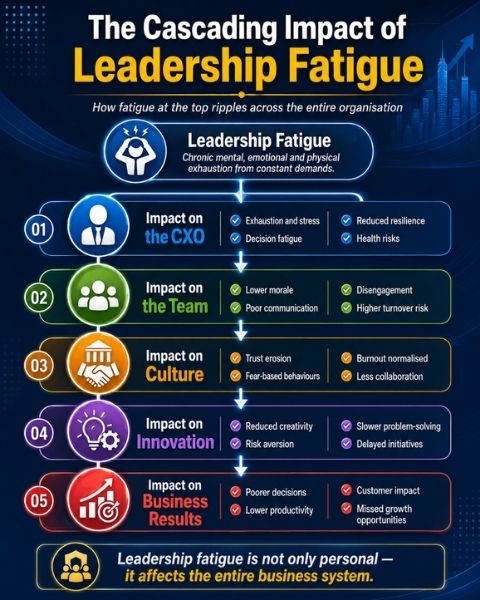
Leadership fatigue is not a private issue. When a CXO is depleted, the effects ripple across the organization.

For the individual leader, unchecked fatigue can damage health, relationships, clarity and confidence. It may lead to chronic stress, emotional withdrawal, career stagnation, or a health crisis that forces an abrupt pause.

The Cascading Impact of leadership fatigue

Leadership fatigue also affects the leadership pipeline. When younger leaders see senior leaders constantly exhausted, unavailable, or emotionally strained, they may begin to associate leadership with personal sacrifice rather than meaningful impact. This can discourage aspiring leaders and weaken succession planning.

In short, leadership fatigue is not merely a wellness concern. It is a business performance issue.

For the organization, the consequences can be serious. Fatigued leaders may make poorer decisions, delay action, avoid innovation, or become overly reactive. Teams may sense the tension and become cautious, disengaged, or fearful. Productivity declines not only because people work less, but because energy, trust and creativity begin to erode.
Recharging the Helm: Practical Strategies for Indian CXOs

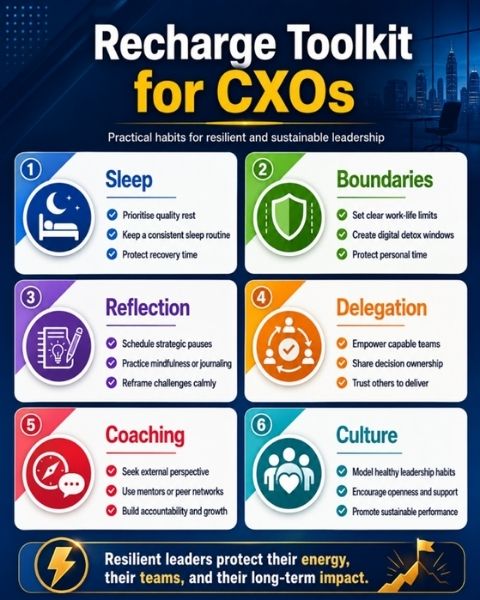
The first step in addressing leadership fatigue is to reframe recovery. Self-care is not indulgence. For CXOs, it is a strategic imperative.

  1. Protect Physical Energy

Sleep, nutrition, movement and medical check-ups are not optional for sustainable leadership. A tired body cannot support clear thinking. Leaders should treat rest as seriously as they treat financial planning or quarterly reviews.

Simple practices can help: fixed sleep routines, regular exercise, mindful eating during travel and short pauses between intense meetings. Even brief recovery windows can improve decision quality.


2. Create Boundaries in an Always-On Culture

Indian CXOs often feel they must be constantly available. But availability without boundaries eventually reduces effectiveness. Leaders can begin by creating protected personal time, setting communication norms and practising digital detox periods.

This does not mean becoming inaccessible. It means becoming intentional.

Mental well-being CXO


3. Build a Resilient Mindset

Leadership resilience is not about pretending everything is fine. It is the ability to face pressure without losing perspective.

A growth mindset helps leaders view challenges as opportunities for learning rather than personal threats. Self-compassion helps them recover from mistakes without excessive self-criticism. Reframing helps them ask, “What is this situation teaching me?” instead of “Why is this happening to me?”


4. Delegate and Empower

Many CXOs become fatigued because they carry decisions that should be distributed. Delegation is not merely a productivity tool; it is a trust-building practice.

Empowered teams reduce the leader’s cognitive load and strengthen organizational capability. Leaders must ask: “What am I holding that someone else is ready to own?”


5. Use Mentors, Peers and Professional Coaching

Leadership can be lonely. A trusted mentor, peer group, or executive coach can provide perspective that is difficult to access from inside the pressure.

Professional coaching offers a confidential space for reflection, objective feedback and tailored strategies. This is where a leadership coach such as Dr. Mathew Thomas can help CXOs identify patterns, strengthen resilience, improve decision-making and build healthier leadership rhythms.


6. Model a Healthier Culture

CXOs shape culture not only through policies but through behaviour. When senior leaders glorify exhaustion, the organization follows. When they model clarity, boundaries, reflection and respect for well-being, others feel permission to do the same.

A resilient organization begins with resilient leadership.

Conclusion: Sustainable Leadership Is a Strategic Strength

Leadership fatigue is real, but it is not inevitable. Indian CXOs can lead with ambition without sacrificing their well-being. The key is to recognize the signs early, build recovery into leadership practice and seek the right support.

Sustainable leadership is not weakness. It is wisdom.

To learn more about building resilient leadership strategies, explore Dr. Mathew Thomas’s leadership coaching and training services or connect for a conversation on strengthening mental well-being for CXOs.