


Leadership is no longer measured only by position, power or the ability to give instructions. In modern organizations, leaders are judged by their ability to influence people, make sound decisions, build trust and create environments where performance is sustainable. This is why the comparison between emotional intelligence leadership and authority leadership has become so important for CXOs, managers, entrepreneurs and emerging leaders.
Both leadership styles have value. Authority leadership gives structure, clarity and direction. Emotional intelligence leadership brings empathy, self-awareness and human connection. The real question is not which style is “good” or “bad” but when each style works, where it fails and how leaders can integrate both with maturity.

What Is Emotional Intelligence Leadership?
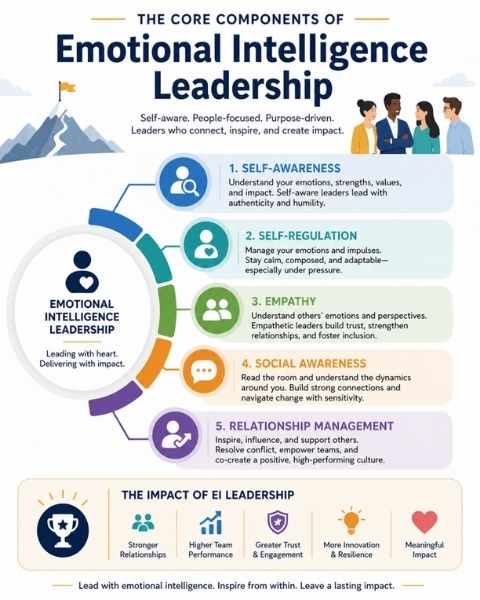
Emotional intelligence leadership is a leadership approach rooted in emotional quotient, often called EQ. It involves the ability to understand one’s own emotions, read the emotions of others, regulate reactions, communicate with empathy and lead people through trust rather than fear.
A leader with strong EQ in leadership is not soft or passive. In fact, emotionally intelligent leaders often make difficult decisions more effectively because they are aware of the emotional climate around those decisions. They can sense resistance, manage conflict, listen actively and communicate change without creating unnecessary panic.
The core principles of emotional intelligence leadership include self-awareness, self-regulation, empathy, social awareness and relationship management. These qualities make it closely connected to transformational leadership and servant leadership. Transformational leadership inspires people toward a shared vision while servant leadership places emphasis on the growth, dignity and development of others.
In practical terms, emotional intelligence leadership helps leaders ask better questions:
What is the team feeling?
What fear is blocking performance?
How can trust be rebuilt?
What does this person need in order to succeed?
This style is especially valuable in today’s workplace where uncertainty, hybrid work, generational diversity and constant change demand more than command-based management.
Benefits of Emotional Intelligence Leadership
The greatest strength of emotional intelligence leadership is building trust. When people feel heard, respected and understood, they are more likely to contribute ideas, accept feedback and stay committed during difficult phases.
It improves communication skills because emotionally intelligent leaders listen before reacting. They avoid unnecessary defensiveness and make space for honest dialogue. This creates psychological safety, which is essential for innovation, accountability and learning.
It also strengthens decision-making. Leaders with high emotional quotient are better able to separate facts from emotional triggers. They do not ignore emotions but they do not become controlled by them either.
Another major benefit is employee engagement. Teams led by emotionally intelligent leaders often experience higher motivation because they feel connected to purpose, not just pressure. This is why EQ in leadership is increasingly viewed as a core competency for effective leadership.
Emotional intelligence leadership can fail when empathy becomes avoidance. Some leaders confuse being emotionally intelligent with keeping everyone comfortable. That can delay hard conversations, weaken accountability and create ambiguity.
Another risk is over-consultation. If a leader spends too much time gathering emotional input without making decisions, the team may lose confidence. Emotional intelligence must support decisiveness, not replace it.
There is also a perception challenge. In highly traditional or hierarchical cultures, emotionally intelligent leadership may be misunderstood as weakness unless it is paired with clarity, boundaries and strategic conviction.
What Is Authority Leadership?
Authority leadership is a leadership style based on formal power, role clarity and the leader’s right to direct action. It is often associated with hierarchy, command, compliance and centralized decision-making.
At its best, authority leadership creates order. It is useful in crisis situations, high-risk environments, military-style operations, manufacturing floors, emergency response, compliance-heavy industries and moments where fast decisions are essential.
Authority leadership answers questions such as:
Who is responsible?
What must be done now?
What standard must be followed?
What are the consequences of delay or failure?
This style is not automatically negative. Many organizations need clear authority. Without it, teams may become confused, slow or politically fragmented. However, authority leadership becomes problematic when leaders rely only on title, fear or control instead of influence, competence and trust.
Benefits of Authority Leadership
Authority leadership provides speed. When there is no time for extended discussion, a clear decision-maker can prevent chaos. This is particularly useful during emergencies, legal issues, major operational breakdowns or urgent business pivots.
It also provides structure. People know reporting lines, decision rights, performance expectations and consequences. For inexperienced teams, authority leadership can reduce confusion and help establish discipline.
Another benefit is consistency. When standards must be maintained across locations, departments or processes, authority leadership can ensure alignment. It prevents endless debate where execution is required.
In short, authority leadership works well when clarity, urgency and compliance matter most.
The limitation of authority leadership is that compliance is not the same as commitment. People may follow instructions because they have to, not because they believe in the direction.
Over time, excessive reliance on authority can reduce initiative. Team members may stop thinking independently, avoid risks and wait for approval. This weakens innovation and slows leadership development.
It can also damage trust. If employees experience authority as control, criticism or emotional distance, they may disengage. In such environments, people often share only what leaders want to hear, which creates blind spots in decision-making.
Authority leadership can produce short-term obedience but emotional intelligence leadership is often better at creating long-term loyalty, ownership and discretionary effort.
Emotional Intelligence Leadership vs Authority Leadership Key Differences
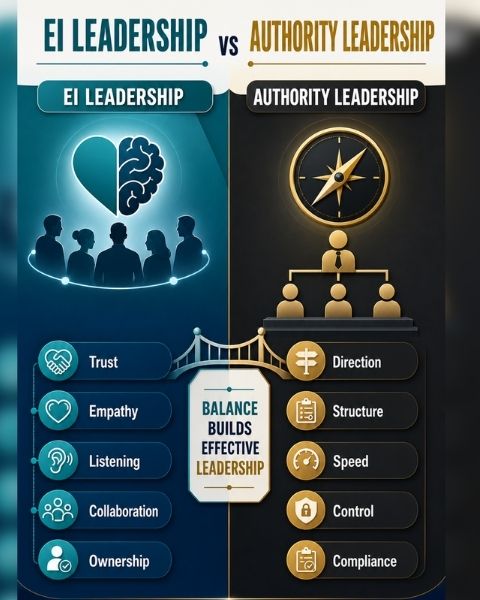
The main difference lies in the source of influence. Emotional intelligence leadership influences through trust, empathy and connection. Authority leadership influences through position, structure and decision rights.
In communication, emotionally intelligent leaders listen, interpret and respond with awareness. Authority leaders instruct, clarify and enforce expectations.
In decision-making, emotional intelligence leadership considers the human impact of decisions while authority leadership focuses on speed, control and execution.
In team culture, emotional intelligence leadership encourages openness, collaboration and shared ownership. Authority leadership creates order, discipline and role clarity.
The most effective leadership styles do not depend on one approach alone. A leader who only uses empathy may struggle with accountability. A leader who only uses authority may struggle with trust. Mature leadership requires the ability to combine emotional intelligence with appropriate authority.
The Integrated Leadership Approach
Dr. Mathew Thomas’ leadership perspective can be positioned around a simple but powerful idea: effective leadership is not about choosing between EQ and authority. It is about knowing when to listen, when to decide, when to support and when to set firm direction.
In transformational leadership, the leader inspires change by connecting people to purpose. In servant leadership, the leader earns influence by serving growth. In authority leadership, the leader provides structure and direction. Emotional intelligence connects all three by helping the leader understand people, context and impact.
A strong leader can say, “I hear your concern” and still say, “This is the decision.” That balance is where credibility is built.
Practical Guidance for Leaders
To strengthen emotional intelligence leadership, begin with self-awareness. Notice what triggers impatience, defensiveness or withdrawal. Leaders who cannot read themselves will struggle to read others.
Practice active listening. Do not listen only to reply. Listen for emotion, hesitation, fear and meaning.
Build trust through consistency. People trust leaders whose words, decisions and behavior align.
Use authority with transparency. Explain why a decision is being made, especially when people do not get what they want.
Develop your emotional quotient through coaching, reflection and feedback. EQ in leadership improves when leaders are willing to examine their impact, not just their intent.
FAQs on Emotional Intelligence Leadership and Authority Leadership
What is emotional intelligence leadership?
Emotional intelligence leadership is the ability to lead through self-awareness, empathy, emotional regulation, active listening and relationship management. It helps leaders build trust, manage conflict and improve team engagement.
Is authority leadership outdated?
No. Authority leadership is not outdated but it is incomplete when used alone. It remains useful in crisis, compliance and high-speed decision-making. However, leaders must combine authority with emotional intelligence to maintain trust and commitment.
Why is EQ in leadership important?
EQ in leadership helps leaders understand emotions, communicate clearly, reduce conflict and make better decisions. It strengthens influence because people are more likely to follow leaders they trust.
Which is better: emotional intelligence leadership or authority leadership?
Neither style is always better. Emotional intelligence leadership is stronger for trust, engagement and transformation. Authority leadership is stronger for clarity, urgency and control. Effective leadership requires both.
How does emotional intelligence support transformational leadership?
Transformational leadership depends on vision, motivation and trust. Emotional intelligence helps leaders connect that vision to people’s emotions, values and aspirations.
Can an authoritative leader also be emotionally intelligent?
Yes. The best leaders use authority without arrogance. They set expectations, make decisions and hold people accountable while still listening, respecting and communicating with empathy.
Conclusion
The future of leadership belongs to those who can combine strength with sensitivity. Authority leadership gives direction but emotional intelligence leadership gives depth. One creates structure, the other creates trust. One can drive action, the other can inspire commitment.
For leaders seeking sustainable influence, the goal is not to abandon authority but to humanize it. A leader who understands emotions, communicates with clarity and uses power responsibly becomes more than a manager. Such a leader becomes a catalyst for growth, transformation and lasting impact.
For professionals, CXOs and organizations, this is the leadership shift that matters most: from command to connection, from control to credibility and from position-based authority to trust-based influence.