
AI-Driven Leadership Is the New Leadership Standard
Leadership has always evolved with the tools of the age. The printing press changed knowledge. The internet changed speed. Mobile technology changed access. Now, generative AI is changing how leaders think, decide, communicate and build organizations.
The question is no longer whether leaders should use AI. The real question is whether leaders can stay effective without understanding AI.
As a leadership coach and trainer, I have seen one clear shift in boardrooms, management meetings and leadership development programs: leaders are not just expected to inspire people. They are expected to make faster decisions, handle complexity, personalize communication, build agile teams and create future-ready cultures.
This is where AI-driven leadership becomes essential.
AI does not replace leadership. It expands leadership capacity. It helps leaders analyze information faster, ask better questions, test ideas, improve communication and support teams with greater clarity. But the human leader remains central.
AI can generate options. Leaders must provide judgment.
AI can summarize data. Leaders must interpret meaning.
AI can improve productivity. Leaders must protect purpose, ethics and trust.
In the generative age, the best leaders will be those who learn to go hand in hand with AI.
What Is AI-Driven Leadership?
AI-driven leadership is the ability of leaders to use artificial intelligence, especially generative AI, to improve decision-making, communication, strategy, innovation and team effectiveness while keeping human judgment, empathy and ethics at the center.
It is not about becoming a technologist. It is about becoming an AI-aware leader.
An AI-driven leader uses AI to:
- Understand trends and business data faster
- Prepare sharper communication for teams and stakeholders
- Generate strategic scenarios
- Improve meeting productivity
- Coach people with better questions
- Analyze employee feedback
- Strengthen decision-making
- Identify risks and blind spots
- Build a culture of learning and innovation
For example, a leader can use ChatGPT, Google Gemini, Microsoft Copilot or a custom enterprise AI model to prepare a town hall message, summarize customer complaints, analyze survey responses or build a leadership development plan.
But the leader must still ask: Is this accurate? Is it ethical? Is it aligned with our values? How will this affect people?
That is the heart of AI-driven leadership: AI plus human wisdom.
Why Leaders Must Go Hand in Hand with AI
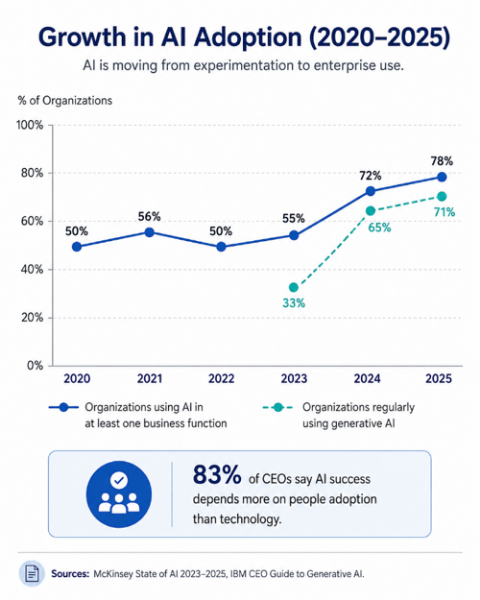
AI adoption is growing quickly across industries. Organizations are using AI for marketing, sales, customer service, operations, finance, HR and strategy. Yet many companies are discovering that AI tools alone do not create transformation.
The real differentiator is leadership.
When leaders do not understand AI, three problems appear:
- AI remains a tool for scattered experiments
- Employees use AI without clear guidance
- Organizations face risks around data, bias, quality and ethics
On the other hand, when leaders understand AI, they can turn it into a strategic capability.
Leaders must go hand in hand with AI because:
-
AI improves speed but leaders provide direction
Generative AI can produce ideas, summaries, frameworks and communication drafts within seconds. But speed without direction can create confusion. Leaders must define the purpose, priorities and boundaries.
-
AI reveals patterns but leaders create meaning
AI can analyze large amounts of information. It can highlight customer patterns, employee sentiment or market signals. But interpretation requires context. A leadership coach, business head or senior manager must connect the insights to people, culture and strategy.
-
AI increases productivity but leaders build trust
Teams may fear that AI will replace jobs. Leaders must communicate clearly that AI is meant to augment human work, not reduce human worth. Leading with AI requires transparency, empathy and psychological safety.
-
AI changes work but leaders shape culture
AI adoption is not only a technology project. It is a culture change. Leaders must encourage experimentation, learning and responsible use.
This is why AI training for leaders is no longer optional. It is becoming a core leadership capability.
The AI-Driven Leadership Framework
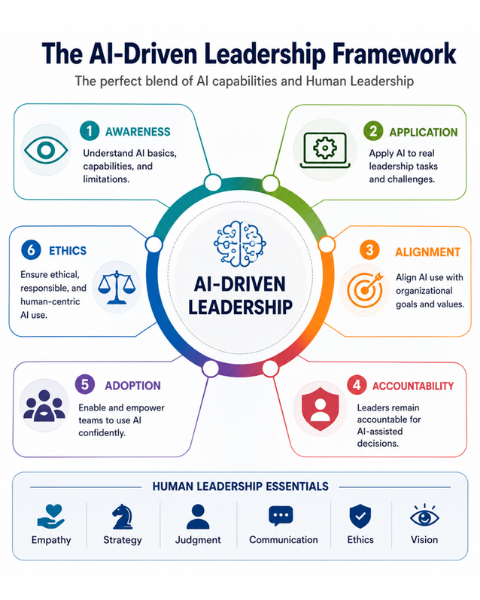
Leaders need a simple framework to integrate AI into daily leadership practice. I recommend the following model:
-
Awareness
Leaders must first understand what generative AI can and cannot do. They need to know the basics of prompts, large language models, hallucinations, bias, privacy and responsible use.
-
Application
The next step is practical use. Leaders should apply AI to real leadership tasks such as communication, decision-making, planning, coaching and performance reviews.
-
Alignment
AI must support business goals. Leaders should ask: Which leadership challenges can AI help us solve? Where can it improve speed, quality or insight?
-
Accountability
Every AI-assisted decision needs human ownership. AI can recommend but leaders remain accountable.
-
Adoption
Leaders must help teams use AI confidently. This includes training, guidelines, encouragement and role modeling.
-
Ethics
AI-driven leadership must be rooted in fairness, transparency, data protection and human dignity.
How Leaders Can Learn Generative AI
Many leaders hesitate because they think AI is too technical. That is a myth. Leaders do not need to code. They need to understand how to think with AI.
Here are practical steps for leaders.
- Start with everyday leadership tasks
Use AI for simple tasks first:
- Drafting meeting agendas
- Summarizing long reports
- Preparing team messages
- Creating learning plans
- Building interview questions
- Writing reflection prompts
- Reviewing presentations
- Creating action checklists
This builds confidence.
- Learn prompt engineering
Prompt engineering is the skill of giving AI clear instructions. A weak prompt gives a generic answer. A strong prompt gives a useful output.
A good leadership prompt includes:
- Role: “Act as a leadership coach”
- Context: “I am preparing for a difficult feedback conversation”
- Goal: “Help me structure the discussion”
- Tone: “Professional, respectful and direct”
- Output: “Give me a step-by-step script”
For example:
“Act as a leadership coach. I need to give feedback to a high-performing employee who is creating conflict in the team. Help me prepare a respectful conversation structure with opening lines, key questions and possible responses.”
- Use AI as a thinking partner
Do not use AI only for writing. Use it for thinking.
Ask AI:
- What are the risks in this decision?
- What assumptions am I making?
- What would a customer say?
- What would an employee worry about?
- What are three alternative strategies?
- What questions should I ask before deciding?
This makes generative AI for leaders a powerful reflection tool.
- Practice human review
AI output must be checked. Leaders should review facts, tone, context and ethical impact before using AI-generated content.
- Build an AI learning routine
Leaders can create a simple weekly routine:
- Monday: Use AI to plan priorities
- Wednesday: Use AI to review communication
- Friday: Use AI to reflect on decisions and learning
Small habits build long-term capability.
AI in Leadership in Action
AI-driven leadership becomes meaningful when it is applied to real business situations.
Example 1: AI for strategic planning
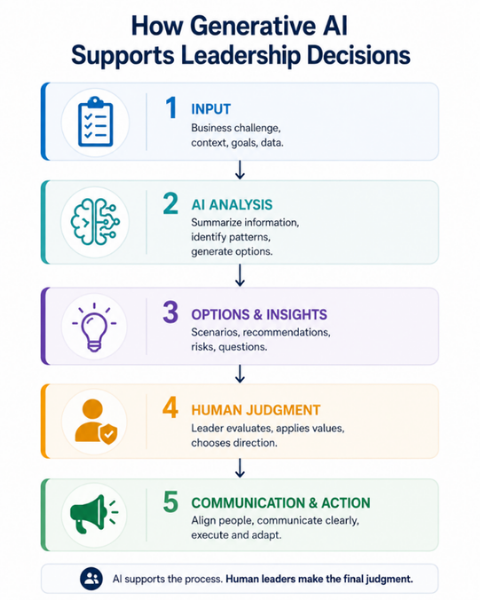
A business head is planning the next financial year. Instead of starting with a blank document, the leader uses AI to generate market scenarios, competitor questions, risk areas and strategic options. The leader then reviews these ideas with the team.
AI helps expand thinking. The leader makes the final decision.
Example 2: AI for coaching conversations
A manager needs to coach a team member who is struggling with ownership. The manager uses AI to prepare open-ended questions, possible objections and a constructive conversation flow.
AI supports preparation. The manager brings empathy.
Example 3: AI for employee feedback analysis
A leadership team receives hundreds of comments from an employee engagement survey. AI helps summarize themes such as workload, trust, role clarity and manager communication.
AI identifies patterns. Leaders decide action.
Example 4: AI for innovation
A team is asked to improve customer experience. The leader uses AI to generate ideas, compare options and create a pilot plan. The team then tests the best ideas with real customers.
AI accelerates ideation. Humans validate reality.
Example 5: AI for leadership communication
During change, leaders often struggle to communicate clearly. AI can help draft messages for different audiences: employees, managers, customers and partners. But the leader must add authenticity, emotion and context.
AI improves structure. Leaders create connection.
Challenges and Ethics in AI-Driven Leadership
AI brings opportunity but also responsibility. Leaders must not treat AI as a magic solution.
- Bias
AI systems can reflect bias from the data they are trained on. Leaders must be alert when using AI for hiring, performance reviews, promotions or people decisions.
- Accuracy
Generative AI can produce confident but incorrect answers. Leaders must verify important information before acting on it.
- Privacy
Sensitive company data, customer information and employee details should not be entered into public AI tools unless the organization has approved it.
- Transparency
Teams should know when AI is being used in important processes. Transparency builds trust.
- Human oversight
AI should support leadership decisions, not make them blindly. Human accountability must remain clear.
- Overdependence
Leaders must avoid outsourcing their thinking to AI. The real value comes from combining AI insight with human experience, values and judgment.
Ethical AI-driven leadership requires a simple rule: use AI to make leadership more human, not less human.
FAQs
What is AI-driven leadership?
AI-driven leadership is the practice of using artificial intelligence to support leadership tasks such as decision-making, communication, strategy, coaching and team management while keeping human judgment and ethics at the center.
How can leaders start learning generative AI?
Leaders can start by using AI for everyday tasks such as summarizing reports, drafting communication, preparing meeting agendas, generating coaching questions and reviewing strategic options. They should also learn basic prompt engineering and responsible AI use.
Does AI replace leadership skills?
No. AI does not replace leadership skills. It supports them. Leaders still need empathy, courage, judgment, vision, ethics and the ability to build trust. AI can provide information and options but leaders must make meaning and take responsibility.
What tools do AI-driven leaders use?
AI-driven leaders may use tools such as ChatGPT, Google Gemini, Microsoft Copilot, Claude, Perplexity or custom enterprise AI systems. The best tool depends on the organization’s security policies, use case and data requirements.
How does AI improve decision-making for leaders?
AI improves decision-making by helping leaders analyze data, identify patterns, generate options, test assumptions and explore risks. However, final decisions should always include human review, business context and ethical judgment.
Conclusion: The Future Belongs to Leaders Who Learn with AI
The generative age will not reward leaders who ignore AI. It will reward leaders who learn it, question it, govern it and use it responsibly.
AI-driven leadership is not about replacing the human side of leadership. It is about strengthening it. It gives leaders more time to think, communicate, coach and create value. But only when it is used with clarity, ethics and purpose.
The leaders of the future will not simply ask, “What can AI do?”
They will ask, “How can AI help me lead with more wisdom, speed, empathy and impact?”
As a leadership coach and trainer, I believe this is the moment for leaders to begin their AI leadership journey. The earlier leaders learn to work with generative AI, the better they will be able to guide their teams, organizations and cultures into the future.
To build this capability, leaders need more than tools. They need guided learning, real practice, ethical clarity and leadership coaching that connects AI with human behavior.
Dr. Mathew’s AI-driven leadership coaching and training programs are designed to help leaders understand generative AI, apply it to real leadership challenges and lead confidently in the age of intelligent technology.
The future of leadership is not human versus AI.
It is human leadership, amplified by AI.
