
Leadership for Gen Z and Leadership by Gen Z: The Future Challenge Organisations Cannot Ignore
Introduction: A New Leadership Question Has Arrived
Every generation changes the workplace. Baby Boomers brought loyalty and stability. Gen X brought independence. Millennials brought purpose, flexibility and digital adoption. Gen Z is now entering organisations with a very different relationship with work, technology, authority, identity and attention.
But the real question is not simply, “How do we lead Gen Z?”
The deeper question is, “How do we prepare Gen Z to lead others?”
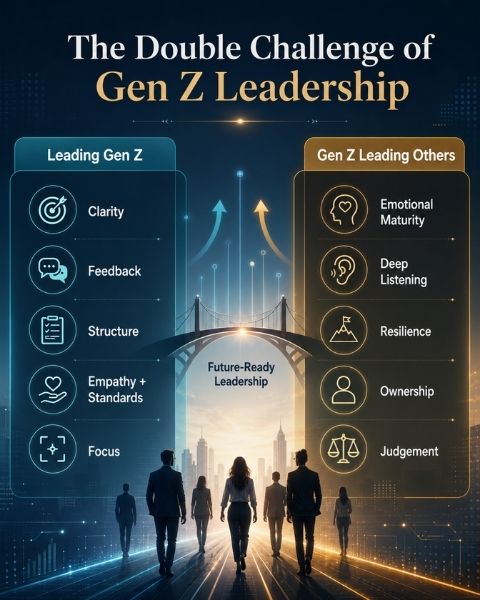
This is where the future challenge lies. Organisations will soon face a double test. Senior leaders will have to learn how to lead Gen Z with empathy, clarity and structure. At the same time, Gen Z will have to develop the depth, patience, resilience and judgement required to lead teams in a complex world.
Leadership for Gen Z and leadership by Gen Z will both be challenged.
As I see it, this is not a generational problem. It is a leadership development opportunity.
Gen Z Is Not Difficult. Gen Z Is Different.
One of the biggest mistakes senior leaders make is labelling Gen Z too quickly. They call them impatient, distracted, entitled or overly sensitive. These labels may sound convenient, but they do not help us lead better.
Gen Z has grown up in a world where information is instant, feedback is immediate, visibility is constant and comparison is endless. Their minds have been shaped by smartphones, social media, short-form content, online learning, digital communities and algorithm-driven attention.
This generation is not less capable. In many ways, they are faster, more informed, more expressive and more comfortable with technology than any generation before them. They can learn tools quickly. They can adapt to digital platforms quickly. They can question old systems quickly.
But speed is not the same as depth.
That is where leadership must step in.
The Attention Economy Has Entered the Workplace
Earlier, distraction was outside the workplace. Today, distraction has become part of everyday life.
Notifications, reels, algorithmic feeds, instant messages and constant content consumption have changed how young professionals process information. Focus is no longer a natural state. It has to be trained.
This is especially important in India. India has one of the largest digital populations in the world. Reports have estimated that by late 2025, India had more than one billion internet users, around 750 million smartphones and nearly 500 million unique social media users. Indians were also estimated to spend more than three hours daily on social media.
This creates a leadership challenge that cannot be ignored.
When young professionals enter the workplace, they bring enormous potential. But many also need support in areas such as deep work, sustained attention, critical thinking, long-form reading, emotional regulation and patience with complex tasks.
The workplace cannot simply blame them. The workplace must develop them.
Why Leading Gen Z Will Be Challenging
Leading Gen Z will require a very different leadership style. Traditional command-and-control leadership will not work. But neither will excessive comfort, over-flexibility or leadership without standards.
The first challenge will be clarity.
Gen Z values transparency. They want to know why something matters, how it connects to a larger purpose and what is expected from them. Leaders who give vague instructions and then expect ownership will struggle. This generation needs clear outcomes, clear timelines, clear boundaries and clear feedback.
The second challenge will be feedback.
Gen Z has grown up in a world of instant feedback. Likes, comments, views and reactions arrive quickly. Workplace feedback is different. It can be slower, more nuanced and sometimes uncomfortable. A client may reject an idea. A manager may point out gaps. A senior leader may challenge a proposal.
Leaders must teach Gen Z that feedback is not rejection. Feedback is data for growth.
The third challenge will be resilience.
The workplace does not always move at the speed of personal preference. Projects get delayed. Promotions take time. People disagree. Effort is not always immediately recognised. One of the key roles of leadership will be to help Gen Z understand that discomfort is not always toxicity, correction is not always criticism and patience is not the same as stagnation.
The fourth challenge will be communication.
Gen Z is highly expressive, but leadership communication requires more than expression. It requires listening, framing, disagreement, negotiation, discretion and emotional maturity. Digital fluency must be converted into professional communication.
Why Leadership by Gen Z Will Be Even More Challenging
The bigger challenge is not only how senior leaders will manage Gen Z. The bigger challenge is how Gen Z will lead when they become managers, project heads, entrepreneurs and business leaders.
Leadership is not simply about confidence. It is about carrying complexity.
A leader must handle disagreement without becoming defensive. A leader must make decisions without complete information. A leader must listen to people who think differently. A leader must hold long-term goals even when short-term emotions are high.
If Gen Z leaders do not consciously build these capabilities, they may struggle in five important areas.
-
Sustained Attention
Leadership requires the ability to stay with a problem long enough to understand it deeply. Many business problems cannot be solved in the first meeting, first message or first idea. Leaders must develop the discipline to think beyond the obvious.
-
Deep Listening
People rarely reveal the real issue in the first sentence. Employees may say they are fine when they are not. Clients may state one problem while hiding another. Teams may agree publicly and resist privately. A leader must listen beyond words.
-
Emotional Regulation
A leader cannot react to every disagreement as a personal attack. Gen Z leaders must learn to hold emotional discomfort. They must be able to receive criticism, manage conflict and respond with maturity.
-
Delayed Gratification
Teams are built over time. Trust is built over time. Credibility is built over time. Leadership is not instant. Young leaders must learn that sustainable success demands consistency, patience and repetition.
-
Judgement
Technology can provide information. AI can provide options. Data can provide patterns. But leaders must still decide what is right, ethical, practical and contextually wise. Judgement will become one of the most valuable leadership skills of the future.
India’s Leadership Moment
India’s demographic advantage is also a leadership responsibility.
We often speak with pride about India’s young workforce. But a young workforce becomes an advantage only when it is developed. Energy alone is not enough. Talent alone is not enough. Digital comfort alone is not enough.
India’s Economic Survey has already highlighted concerns around digital addiction and youth mental health, especially among the 15 to 24 age group. It has connected excessive digital use with issues such as anxiety, depression, low self-esteem, compulsive scrolling, social comparison and gaming disorders.
This is not only a health issue. It is also a workplace issue.
If young professionals are entering organisations with reduced attention span, higher anxiety, lower tolerance for ambiguity and constant digital stimulation, leadership development must be redesigned.
Organisations cannot wait for people to become managers before teaching leadership. Leadership development must begin from the first year of employment.
What Senior Leaders Must Do Differently
The solution is not to become soft. It is not to become harsh either. The solution is to become more intentional.
-
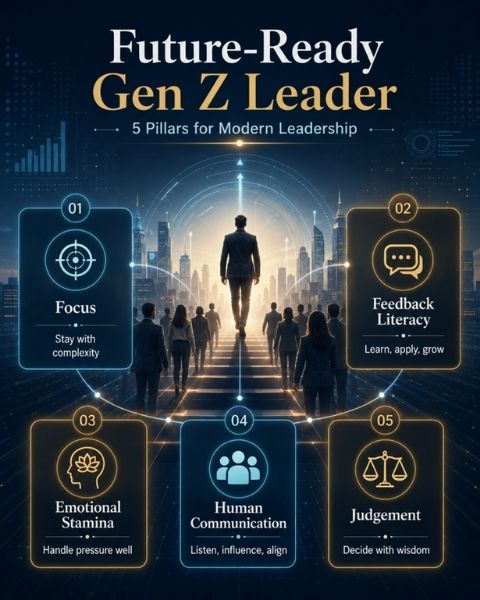
Build Focus as a Workplace Skill
Focus must be treated as a professional competency. Leaders must create space for deep work, reduce unnecessary meetings, discourage constant interruption and help employees complete cognitively demanding work without continuous switching.
-
Give Structure Before Freedom
Young employees do not need micromanagement, but they do need structure. Clear expectations, defined outcomes, timelines, decision rights and review mechanisms help them perform better.
Freedom without structure creates confusion. Structure with trust creates growth.
-
Teach Feedback Literacy
Feedback should not be limited to annual reviews. Gen Z must be trained to ask for feedback, receive feedback, interpret feedback and act on feedback. This is one of the strongest bridges between potential and performance.
-
Develop Emotional Stamina
Emotional intelligence is not only about empathy. It is also about composure. Young professionals must learn how to manage pressure, disappointment, disagreement and uncertainty without losing balance.
-
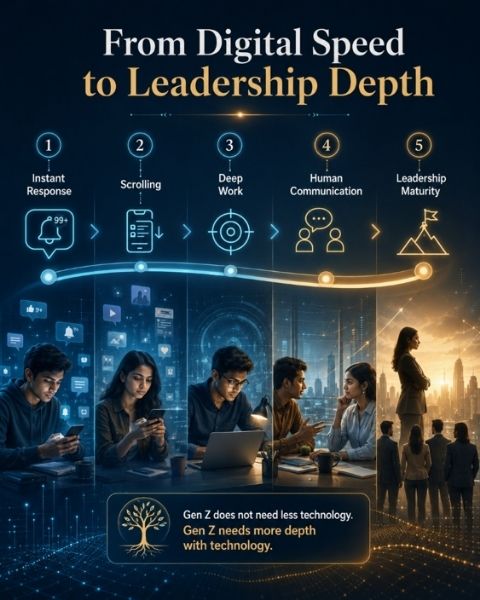
Balance Digital Speed with Human Depth
Gen Z may be faster with technology, tools and AI. That is a strength. But leadership is still deeply human. The future belongs to those who can combine digital speed with human depth.
-
Start Leadership Development Early
Ownership, accountability, professional communication, discretion, problem-solving and decision-making must be taught from the beginning. These cannot be postponed until promotion.
What Gen Z Must Learn About Leadership
Gen Z also has a responsibility.
The world of work cannot be redesigned entirely around personal comfort. Growth requires adaptation from both sides.
Young professionals must understand that being heard is important, but so is learning to listen. Flexibility is important, but so is reliability. Mental health is important, but so is mental toughness. Speed is important, but so is depth. Authenticity is important, but so is professionalism.
The leader of the future cannot be merely expressive. The leader of the future must be reflective.
The future-ready Gen Z leader will not be the one who knows every tool. It will be the one who knows how to think.
It will be the one who can pause before reacting.
Listen before judging.
Question before rejecting.
Commit before expecting rewards.
Use technology without becoming controlled by it.
Lead people without losing humanity.
This is the kind of leadership India will need.
Conclusion: This Is Not a Generational War
The coming years will test both senior leaders and Gen Z.
Senior leaders will be tested on whether they can guide a generation they do not fully understand. Gen Z will be tested on whether they can rise beyond digital comfort and build the depth required for real leadership.
This is not a generational war. It is a leadership opportunity.
If we lead Gen Z only through criticism, we will lose their energy. If we lead them only through comfort, we will weaken their capability.
The real task is to create a leadership culture that combines empathy with standards, flexibility with discipline and digital intelligence with human wisdom.
The future of leadership will not be decided by which generation is smarter.
It will be decided by which generation is willing to grow.
