
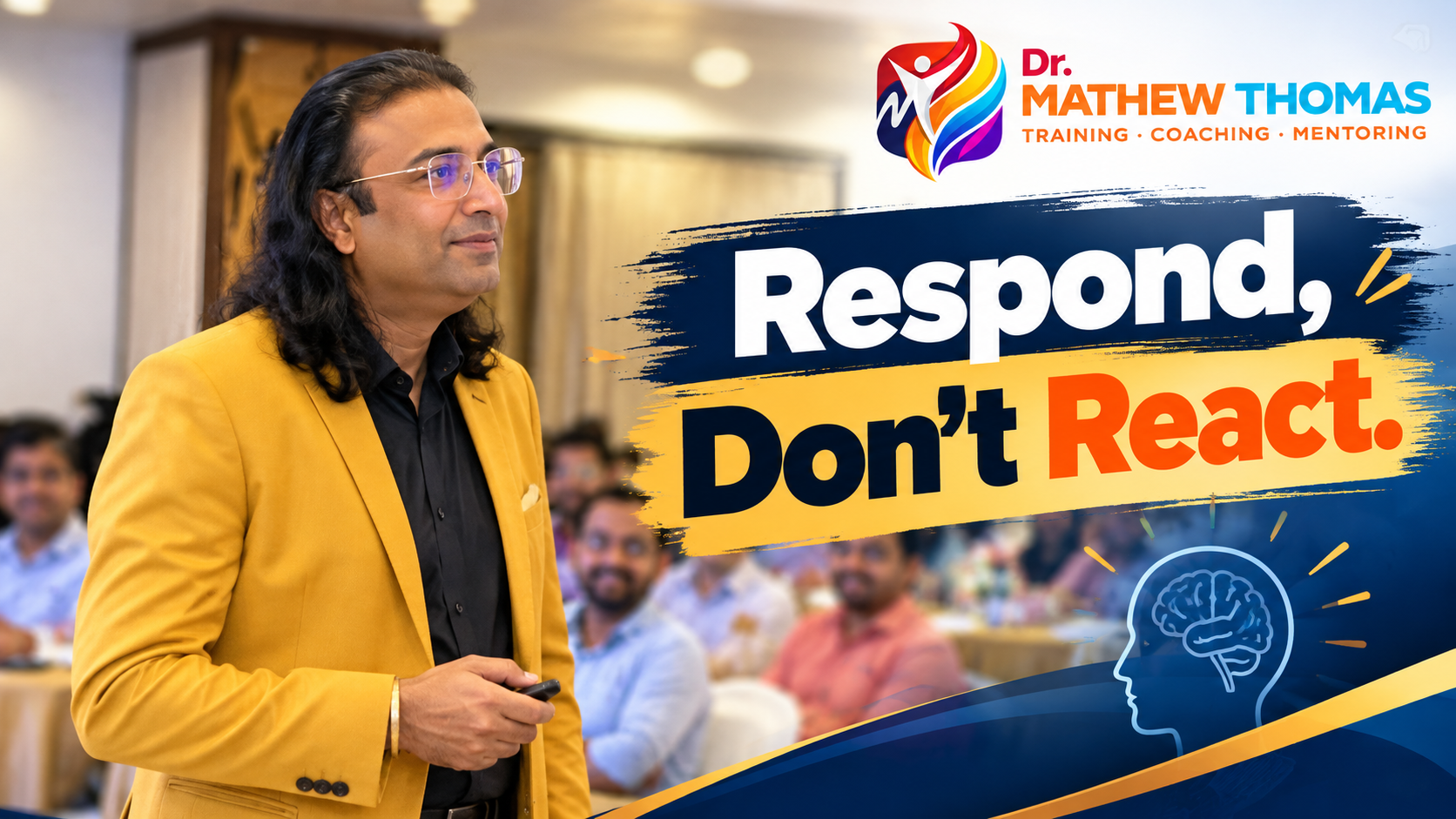

Why Controlling Your Reaction Is More Important Than Winning an Argument
The meeting is going well — until someone challenges your point. Perhaps a colleague questions your recommendation. A manager criticises a decision you made. A team member disagrees with you in front of others. You feel the shift immediately. Your tone becomes sharper. You interrupt. You begin collecting arguments in your head instead of listening. And suddenly, the objective of the conversation changes — you are no longer trying to solve the problem, you are trying to win.
You may even succeed. You may prove that your numbers were correct, your reasoning was stronger, or the other person misunderstood the situation. But what did you actually win? If the conversation leaves behind resentment, defensiveness or damaged trust, being right can become a surprisingly expensive victory.
In leadership development conversations and emotional intelligence training, this is one of the most important distinctions professionals need to understand: winning an argument and creating the right outcome are not the same thing.
Winning the Argument Is Not the Same as Winning the Outcome
Workplace disagreements are inevitable. In fact, disagreement can be valuable — different perspectives can expose risks, challenge assumptions and improve decisions. The problem is not disagreement. The problem begins when disagreement becomes personal.
When people feel criticised, misunderstood, embarrassed or disrespected, they may become defensive. Instead of examining the issue, they start protecting their position, competence or credibility. That can quickly change the quality of a conversation — listening decreases, interruptions increase, tone becomes harder, and people begin defending yesterday’s statements rather than solving today’s problem.
A professional may “win” the argument but lose something far more important: trust, collaboration and influence. And from a leadership perspective, that loss matters. A manager who repeatedly needs to prove that he or she is right may gradually create a team that stops speaking openly — people begin agreeing publicly and disagreeing privately, and valuable challenges disappear from the room.
The more useful question, therefore, is not “how do I prove that I am right?” It is “what response will create the best outcome from here?” That shift is at the heart of emotional intelligence.
What Emotional Intelligence Looks Like at Work
Emotional intelligence is sometimes misunderstood as being pleasant, agreeable or calm at all times. It is none of those things. In practical workplace situations, emotional intelligence involves four closely connected capabilities:
- Self-awareness: Recognising what you are feeling and noticing how that emotion may be influencing your interpretation of the situation.
- Self-regulation: Managing your behaviour so that a temporary emotion does not automatically determine your response.
- Empathy: Making an effort to understand what another person may be seeing, experiencing or trying to communicate — even when you disagree.
- Relationship management: Communicating in a way that allows difficult issues to be addressed without unnecessarily damaging the working relationship.
These are not merely interpersonal niceties. They are leadership capabilities. In leadership workshops, one recurring reality is that many professionals are highly competent when the situation is logical, structured and predictable. The real test begins when a conversation becomes emotionally uncomfortable — that is when self-awareness, listening, emotional regulation and communication discipline become visible.
Between the Trigger and the Response
Someone says: “I don’t think this proposal has been thought through properly.” Your first interpretation might be: “They think I am incompetent.” But that is an interpretation, not necessarily a fact. The emotional trigger may be immediate. Your response does not have to be.
A pause of a few seconds can create enough space to ask: what am I feeling? What am I assuming? What actually needs to happen next? Perhaps the comment was poorly worded. Perhaps there is a genuine weakness in the proposal. Perhaps the other person has information you do not have. Or perhaps the comment really was inappropriate. In every case, reacting impulsively reduces your choices. Emotional regulation expands them.
And regulation is not suppression. Suppressing emotion means pretending anger, disappointment or frustration does not exist. Regulating emotion means recognising it without handing it control of your behaviour. You can be angry and still speak intelligently. You can disagree strongly and remain respectful. You can set a boundary without losing control. That is emotional maturity — and it is also a significant part of leadership maturity.
Two Conversations, Two Very Different Outcomes
Situation 1: Your manager criticises your work. Your manager says, “This isn’t what I expected. There are several gaps here.” An impulsive response might be, “I followed exactly what you told me. The expectations weren’t clear in the first place.” There may even be some truth in that statement, but defensiveness introduced too early can turn a conversation about improving the work into an argument about responsibility.
An emotionally intelligent response could be: “I want to understand the gaps clearly. Can you walk me through the two or three areas you believe need the most attention?” Notice what changed — you have not accepted blame, you have not agreed that the criticism is completely justified. You have simply chosen understanding before defence. Once the facts are clear, you can explain your perspective more effectively.
Situation 2: A colleague challenges you in a meeting. Imagine a colleague says, “We’ve already tried something similar. I don’t think this is going to work.” The instinctive response might be, “That’s not correct. What we tried previously was completely different.” Now both people are defending positions.
A more emotionally intelligent response might be: “There are similarities, but I see an important difference. Before I explain it, what specifically from the previous experience concerns you?” That question changes the conversation — instead of fighting the objection, you investigate it. This ability to remain curious under challenge is especially important for leaders. Leadership credibility is not strengthened by having the final word in every room. It is strengthened when people see that you can absorb disagreement without becoming threatened by it.
Five Ways to Manage Your Reaction Under Pressure
- Pause before answering. A short pause can prevent an emotional reaction from becoming a professional mistake. Try: “Give me a moment to think about that.”
- Name the emotion privately. Ask yourself: am I angry, embarrassed, threatened, frustrated or simply surprised? Naming what you are experiencing helps separate the emotion from the decision about what to do next.
- Separate facts from assumptions. Before reacting, ask: what do I actually know, and what am I interpreting? This matters especially when tone, emails or short comments leave room for misunderstanding.
- Ask before you defend. Clarifying questions slow down escalation. Try: “When you say this isn’t working, which part concerns you most?”
- Be calm without becoming passive. Emotional intelligence does not require weak language. Try: “I understand your concern. I see the situation differently, and I’d like to explain why.”
That last response is both respectful and assertive — which is exactly the balance emotional intelligence requires.
Emotional Intelligence Does Not Mean Tolerating Everything
This distinction matters. Controlling your reaction does not mean remaining silent when behaviour is inappropriate. It does not mean tolerating bullying, discrimination, repeated disrespect, unethical conduct or serious misconduct. Sometimes emotional intelligence means setting a very clear boundary: “I am willing to discuss the issue, but I don’t think speaking to each other in this manner will help us resolve it.” In more serious situations, the appropriate response may involve documenting what happened, seeking support or escalating the matter through the correct organisational channels.
Similarly, leaders cannot always wait for everyone to agree. There are moments when perspectives must be heard, alternatives considered — and a decision made. One of the most important lessons in leadership development is that maturity does not mean avoiding firmness. It means being able to exercise firmness without unnecessary aggression.
The emotionally intelligent leader is not necessarily the person who creates consensus every time. It is the person who can remain clear without becoming aggressive, empathetic without becoming indecisive, and assertive without becoming reactive — a balance built through structured leadership coaching.
A Leadership Trainer’s Perspective
In leadership training, difficult conversations reveal far more about a leader than comfortable ones do. Most professionals know how they would like to behave under pressure. The challenge is what happens when pride, frustration, anxiety or the need to defend credibility enters the conversation. That is where emotional intelligence becomes practical.
The real work is not simply learning communication techniques. It is developing the awareness to recognise your internal reaction before it begins driving your external behaviour. A leader’s emotional response also affects more than the leader — teams watch. They notice whether disagreement is welcomed or punished, whether mistakes can be discussed openly, and whether a leader listens before judging. Over time, these reactions shape the communication culture of the team.
That is why emotional intelligence is not a “soft” addition to leadership. It is one of the mechanisms through which trust, accountability, candour and collaboration are either strengthened — or weakened. This is central to the leadership training programmes Dr. Mathew Thomas delivers for managers and senior leaders across India.
Frequently Asked Questions
1. What is emotional intelligence at work?
It is the ability to be self-aware, regulate your own reactions, understand others’ perspectives through empathy, and manage relationships so that difficult issues can be addressed without unnecessarily damaging trust.
2. Does emotional intelligence mean avoiding conflict or disagreement?
No. Disagreement is often valuable because it exposes risks and improves decisions. Emotional intelligence is about how disagreement is handled — staying curious and respectful rather than letting it become personal or defensive.
3. How can I control my reaction when someone criticises my work?
Pause before answering, separate facts from assumptions, and ask clarifying questions before defending your position. Choosing understanding before defence often leads to a far more productive outcome than reacting immediately.
4. Is emotional intelligence the same as being passive or agreeable?
No. Emotional intelligence does not mean tolerating inappropriate behaviour or avoiding firm decisions. It means being able to be clear and assertive without becoming aggressive or reactive.
5. Can emotional intelligence be developed through training?
Yes. Through deliberate practice and structured leadership training, professionals can build self-awareness and self-regulation skills that help them respond more effectively under workplace pressure.
Before You Win the Argument, Ask What You Might Lose
The next time somebody challenges your opinion, criticises your work or says something that immediately triggers you, notice the urge to respond. Then create a small gap — not because you are weak, not because the other person is necessarily right, but because your response deserves more thought than your reaction.
The temporary satisfaction of proving someone wrong rarely compares with the long-term value of trust, credibility and healthy professional relationships. You do not need to win every argument to demonstrate strength. Sometimes the greater strength is being able to say: “I disagree. But I am going to choose how I respond.” That is emotional regulation. That is professional maturity. And very often, that is leadership.
Dr. Mathew Thomas is a leadership trainer and executive coach based in Mumbai, helping managers and leaders across India build emotional intelligence, communication and conflict-resolution skills through structured leadership training programmes. Visit the home page to learn more, or find Mentora India on Google Maps.