


In times of crisis, organisations do not merely look for decisions — they look for leadership communication that inspires confidence, clarity and direction.
Whether it is economic disruption, organisational restructuring, reputational challenges, or unforeseen global events, crises test not only a leader’s strategy but also their ability to communicate effectively.
One truth becomes increasingly clear: during a crisis, communication is leadership.
The way leaders communicate during uncertainty often determines whether teams remain engaged, anxious, resilient, or disconnected.
Why Leadership Communication Matters More During Crisis
When uncertainty rises, information gaps are quickly filled by assumptions, rumours, and fear.
Employees begin asking silent questions:
What is happening?
Are we safe?
Can we trust leadership?
What happens next?
At such moments, people do not expect leaders to possess all the answers. However, they expect leaders to demonstrate clarity, honesty, empathy, and visible direction.
Poor communication amplifies confusion.
Strong leadership communication builds trust.
Great leaders understand that crisis communication is not about delivering perfect messages. It is about delivering authentic, timely, and credible communication that stabilises people and organisations.
The Five Pillars of Effective Leadership Communication During Crisis
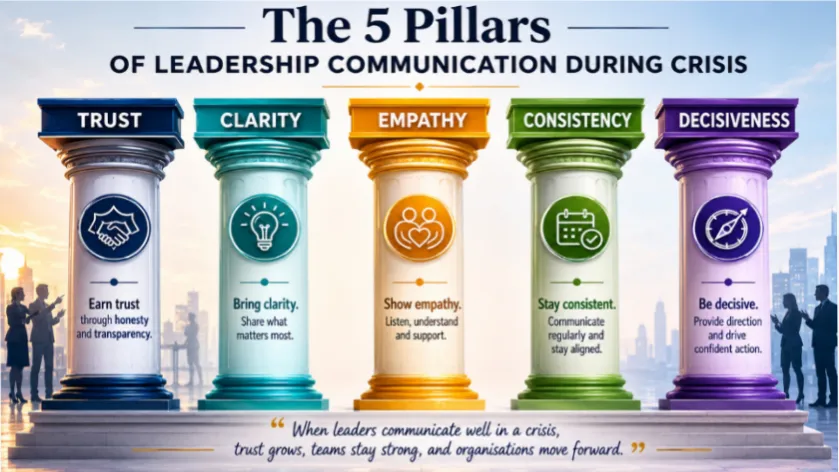
Clarity Over Complexity
During crisis situations, leaders often overwhelm teams with excessive explanations, technical jargon, or incomplete narratives.
Effective leaders simplify.
They communicate what matters most:
- What is happening
- What it means
- What actions are being taken
- What people should expect next
Clarity reduces uncertainty and creates psychological stability.
Communication should never create more confusion than the crisis itself.
Empathy Before Authority
One of the most overlooked dimensions of crisis leadership communication is emotional intelligence.
People remember how leaders made them feel during difficult moments.
Acknowledging concerns, recognising stress, and demonstrating genuine human understanding do not weaken leadership credibility — they strengthen it.
Empathy is not softness.
It is strategic leadership maturity.
Leaders who communicate with empathy create stronger emotional commitment, higher trust, and deeper organisational resilience.
Consistency Builds Credibility
Inconsistent communication damages trust faster than bad news.
Employees can handle difficult realities better than unpredictable messaging.
High-impact leaders maintain a disciplined communication rhythm.
They communicate regularly.
They avoid long silences.
They align messaging across leadership teams.
Consistency reassures people that leadership remains engaged, visible, and accountable.
Transparency Creates Trust
Many leaders hesitate during crises because they fear sharing incomplete information.
However, silence often generates greater anxiety than uncertainty.
Transparency does not mean disclosing everything.
It means communicating honestly about what is known, what remains uncertain, and what is being done to address the situation.
Trust grows when leaders say:
“Here is what we know today.”
“Here is what we are still evaluating.”
“Here is our commitment moving forward.”
Transparency humanises leadership.
Decisive Communication Drives Action
Communication without direction creates paralysis.
Strong leaders ensure their messaging leads to action.
Teams need clear priorities, defined expectations, and visible leadership intent.
Decisive communication helps people move from uncertainty toward execution.
In crisis environments, leadership visibility and communication agility become powerful competitive advantages.
Common Leadership Communication Mistakes During Crisis
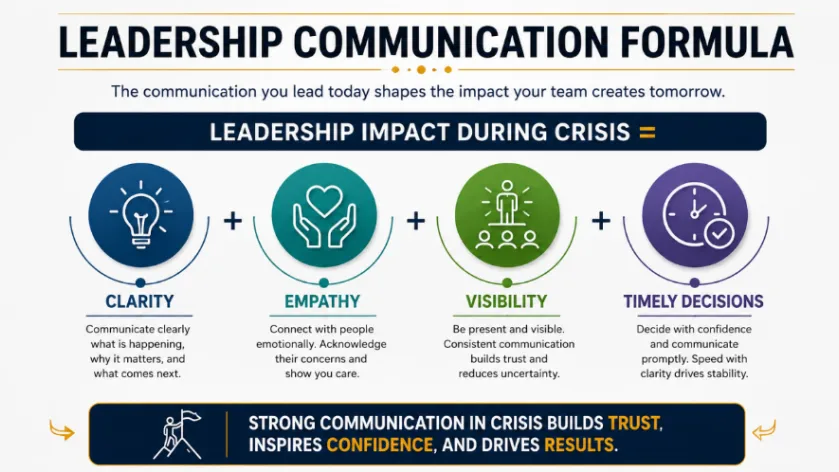
Through years of leadership coaching and mentoring leaders across industries, I have observed recurring communication patterns that weaken leadership effectiveness during difficult times.
Some of the most common mistakes include:
- Delayed communication
- Overpromising outcomes
- Avoiding difficult conversations
- Communicating only facts without emotional context
- Sending mixed messages across leadership levels
Leadership communication during crisis is not about protecting authority.
It is about strengthening trust.
And trust is built through intentional communication behaviours.
What Exceptional Leaders Do Differently
Exceptional leaders understand a fundamental principle:
People follow certainty when available — but they follow credibility when certainty is absent.
The most respected leaders communicate early, communicate often, and communicate with authenticity.
They remain visible.
They listen actively.
They adapt messaging as situations evolve.
Most importantly, they recognise that leadership communication is not an event — it is an ongoing strategic responsibility.
In today’s volatile and rapidly changing world, leadership communication during crisis is no longer an optional leadership capability.
It is a defining leadership differentiator.
As leaders, our responsibility is not merely to manage crises.
Our responsibility is to communicate in ways that strengthen trust, inspire resilience, and create forward momentum even in uncertainty.
Because ultimately, people may forget the crisis.
But they rarely forget how leadership communicated through it.
— Dr. Mathew Thomas
Leadership Coach | Certified International Master Mentor