
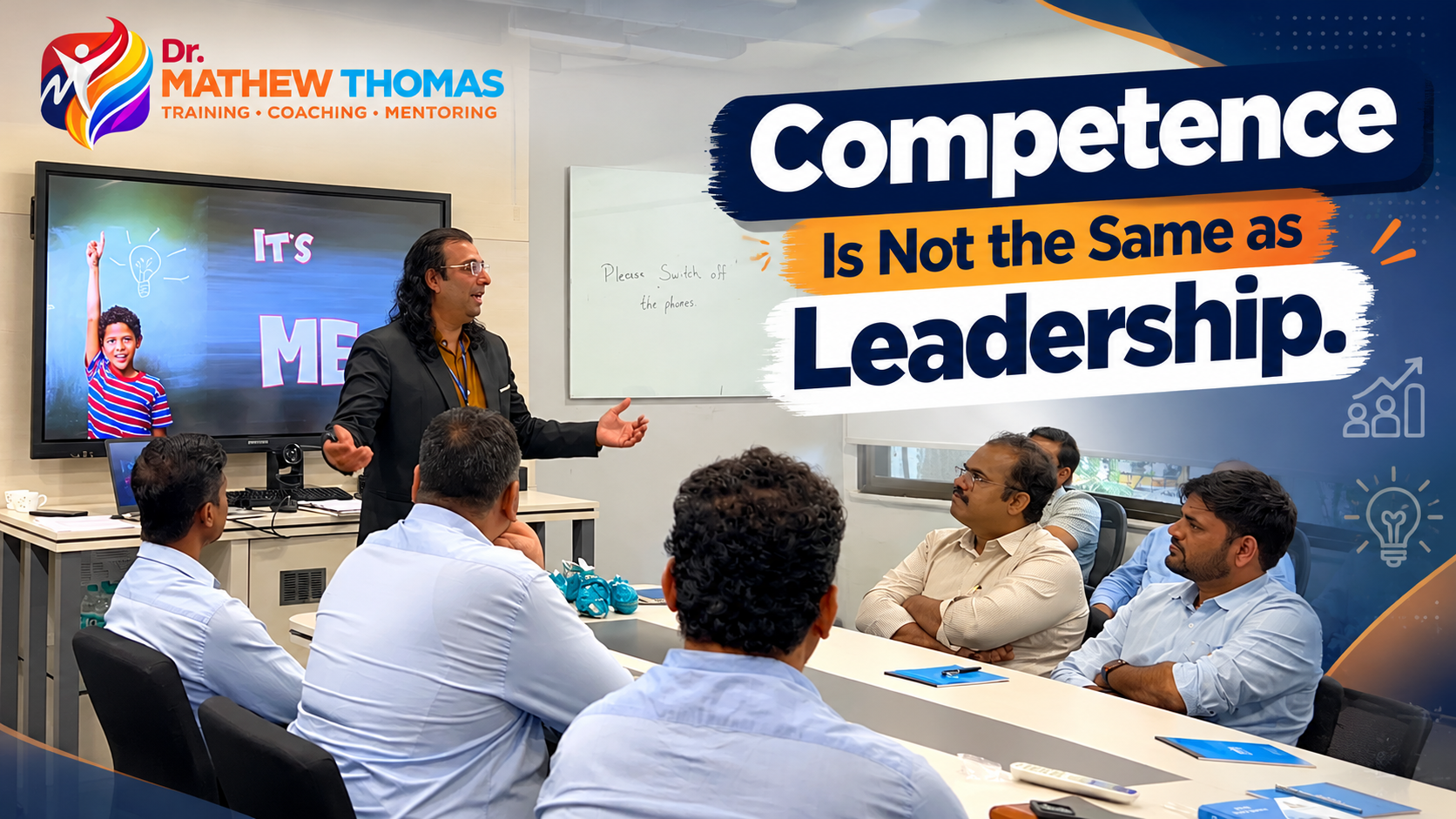

When Competent Managers Fail to Lead People
There is a leadership problem inside many organisations that rarely gets discussed openly. Some of the most difficult managers to work with are not incompetent. In fact, they are often exceptionally competent. They understand the business. They know the process. They solve problems quickly. They deliver numbers. They work hard. They have earned credibility through years of performance. And that is exactly why they get promoted.
But somewhere after the promotion, the equation changes. The person who was once rewarded for having the answers is now expected to develop people who can find their own answers. The person who succeeded by taking control is now expected to empower. The person whose individual performance created value is now responsible for creating performance through others.
That transition sounds logical on paper. In practice, it is one of the hardest shifts covered in leadership training in Mumbai and across India.
The Competence Trap
Organisations often assume that professional competence naturally evolves into leadership capability. It does not. A technically strong manager may know exactly what needs to be done and still struggle to get the best out of people.
Why? Because tasks are predictable in ways that people are not. A process can be corrected. A spreadsheet can be reviewed. A target can be measured. People bring ambition, insecurity, emotion, pride, fear, disagreement, personal history and different ways of thinking into the workplace. That is where managerial competence reaches its limit.
Consider a high-performing sales professional who becomes a sales manager. Whenever a team member struggles, the manager immediately takes over the account because, in the manager’s mind, the priority is obvious: close the deal. The deal may get closed. But something else happens quietly — the employee becomes less confident, the manager becomes increasingly indispensable, and the organisation creates dependence instead of capability.
The manager may still look successful because the numbers are being delivered. But is this leadership? That is the competence trap — when leaders continue doing what made them successful as individual contributors, even after the role has fundamentally changed.
When Results Hide Leadership Problems
One of the reasons poor people leadership survives for so long is that performance can hide it. A team may continue delivering because employees are experienced. Customers may continue buying. Targets may continue being achieved. The manager therefore appears effective.
But beneath the visible results, another reality may be developing: people stop disagreeing openly, strong employees begin withholding ideas, team members wait for instructions rather than taking initiative, conversations become transactional, mistakes are hidden, and people learn what the manager wants to hear.
This is where organisations need to distinguish between performance created by leadership and performance achieved despite leadership. The difference may not be obvious in one quarter. Over time, however, it becomes visible in employee engagement, collaboration, innovation, retention and the quality of future leaders being developed. A manager can push people to deliver. A leader creates an environment where people want to contribute. Those are two very different forms of performance.
Emotional Intelligence Is Not About Being “Nice”
Emotional intelligence is sometimes misunderstood as softness. It is almost the opposite. Emotionally intelligent leadership requires the maturity to face difficult realities without allowing ego, frustration or insecurity to control the conversation. It is the ability to notice your own emotional state before reacting, to understand why another person may be responding differently from what you expected, to challenge performance without attacking identity, and to know when to speak, when to listen and when silence is telling you something important.
Imagine two managers receiving the same disappointing piece of work. The first reacts immediately: “How could you get something this basic wrong?” The second says: “This is below the standard we agreed. Walk me through how you approached it.” Both managers are addressing poor performance. But they are creating completely different environments — the first conversation creates defensiveness, the second creates accountability and diagnosis. That distinction is emotional intelligence in action.
Self-Awareness Is Where Leadership Begins
Most managers are highly aware of what their teams need to improve. Far fewer are equally aware of their own impact. That is one of the biggest blind spots in leadership. A manager may believe, “I am only being direct” — the team may experience intimidation. A manager may believe, “I am protecting quality” — the team may experience micromanagement. A manager may believe, “I am available whenever they need me” — the team may have learned not to make decisions without approval.
Leadership intention and leadership impact are not always the same. A useful question for every leader is: what behaviour in my team might I be unintentionally creating? If people never challenge you, is that because you are always right, or because disagreement has become uncomfortable? If people constantly seek your approval, is that because they lack capability, or because previous independent decisions were second-guessed?
Leadership becomes more powerful when managers stop examining only the behaviour of others and begin examining the environment their own behaviour creates.
The Real Test of Communication
Leadership communication is not simply the ability to speak clearly. Many competent managers are excellent communicators when presenting information, explaining a plan or giving instructions. The harder test comes when communication becomes emotionally uncomfortable: can you tell a valued employee that their behaviour is affecting the team? Can you receive criticism from a junior colleague without defending yourself? Can you disagree strongly without making disagreement personal? Can you say, “I made the wrong call”?
These moments reveal far more about leadership than polished presentations ever will. Trust is usually built or weakened in small conversations — a delayed feedback discussion, a public interruption, a private acknowledgement, a leader taking credit, a leader sharing credit, a mistake being punished, a mistake being explored. Employees remember these moments and gradually form an answer to one question: is it safe for me to be honest here? That answer influences everything from innovation to accountability.
Psychological Safety Does Not Mean Comfortable Leadership
Another misunderstanding is that psychological safety means making people comfortable. It does not. A psychologically safe team can still have demanding standards. In fact, strong teams often have difficult conversations more frequently than weak teams. The difference is that disagreement is not treated as disloyalty, questions are not treated as incompetence, and mistakes are not automatically treated as character flaws. People know they can speak honestly and still be respected.
That creates an interesting paradox: when employees feel safer speaking up, leaders hear more uncomfortable information. But that is exactly what strong leadership requires. A leader surrounded only by agreement is not necessarily leading a healthy team. Sometimes the most important information in an organisation is the information nobody feels comfortable telling the leader.
From Control to Capability: Five Shifts That Matter
Perhaps the biggest shift in leadership is moving from controlling performance to creating capability. Control feels efficient — tell people what to do, check progress frequently, correct mistakes quickly, stay involved. The problem is that excessive control solves today’s uncertainty by creating tomorrow’s dependence. Leadership requires a longer-term perspective.
- From solving to questioning: before giving the answer, ask “what do you think we should do?” The goal is to develop judgment.
- From instruction to ownership: make outcomes, decision rights and accountability clear, not just tasks.
- From feedback as correction to feedback as development: create frequent conversations about behaviour, decisions, strengths and improvement.
- From being the smartest person in the room to creating the smartest room: leadership is about conditions, not demonstrations of knowledge.
- From personal indispensability to team capability: the strongest evidence of leadership is often what happens when the leader is absent.
Does the team still think, decide, collaborate and take ownership without you? That is leadership maturity — and it is exactly what structured leadership coaching and mentoring is built to develop.
The Leadership Question Organisations Should Be Asking
When organisations evaluate managers, they naturally look at business results. They should — results matter. But results alone tell an incomplete story. A second set of questions is equally important: what kind of people are developing under this leader? Are team members becoming more confident or more dependent? Are good people willing to challenge ideas? Does the team collaborate when pressure rises? Are difficult conversations happening early or being avoided? Is the manager creating more future leaders?
Because leadership should not only be measured by the performance a manager personally drives. It should also be visible in the capability that grows around them.
Frequently Asked Questions
1. Why do some highly competent managers struggle to lead people?
Because professional competence and people leadership are different skill sets. Technical competence is about solving predictable problems; leadership is about navigating ambition, emotion, disagreement and trust — skills that are not automatically tested by technical success.
2. What is the “competence trap” in leadership?
It is when leaders continue doing what made them successful as individual contributors even after their role has changed to leading others, creating dependence on the manager instead of capability within the team.
3. How can leaders tell if their results are hiding a leadership problem?
Watch for signs like people no longer disagreeing openly, strong employees withholding ideas, team members waiting for instructions, and mistakes being hidden rather than discussed — these often surface before performance numbers do.
4. Is emotional intelligence the same as being nice as a manager?
No. Emotional intelligence is the maturity to address difficult issues productively, without letting ego or frustration take over the conversation. It involves maintaining standards while managing yourself well, not lowering expectations.
5. How can leadership training help competent managers lead better?
Structured leadership training builds self-awareness, emotional intelligence, coaching and delegation skills that technical competence alone does not develop, helping managers shift from controlling performance to building capability in their teams.
The Real Leadership Crisis
The leadership crisis nobody talks about is not a shortage of intelligent, ambitious or technically competent managers. Organisations have plenty of them. The challenge is that we sometimes mistake competence for leadership readiness. We promote people because they have proved they can deliver. Then we assume they will automatically know how to create trust, navigate emotion, handle conflict, give difficult feedback, inspire ownership and develop people. Those capabilities do not appear automatically with a new designation.
Leadership begins when managers understand that the role is no longer simply about their own ability to perform. It is about the environment they create for other people to perform. And perhaps one question captures that transition better than any leadership competency model: when people work with me, do they become more dependent on my capability — or more confident in their own?
— Dr. Mathew Thomas is a leadership trainer and executive coach based in Mumbai, helping managers across India make this exact transition. Explore his leadership training programmes or one-on-one coaching, visit the home page, or find Mentora India on Google Maps.