
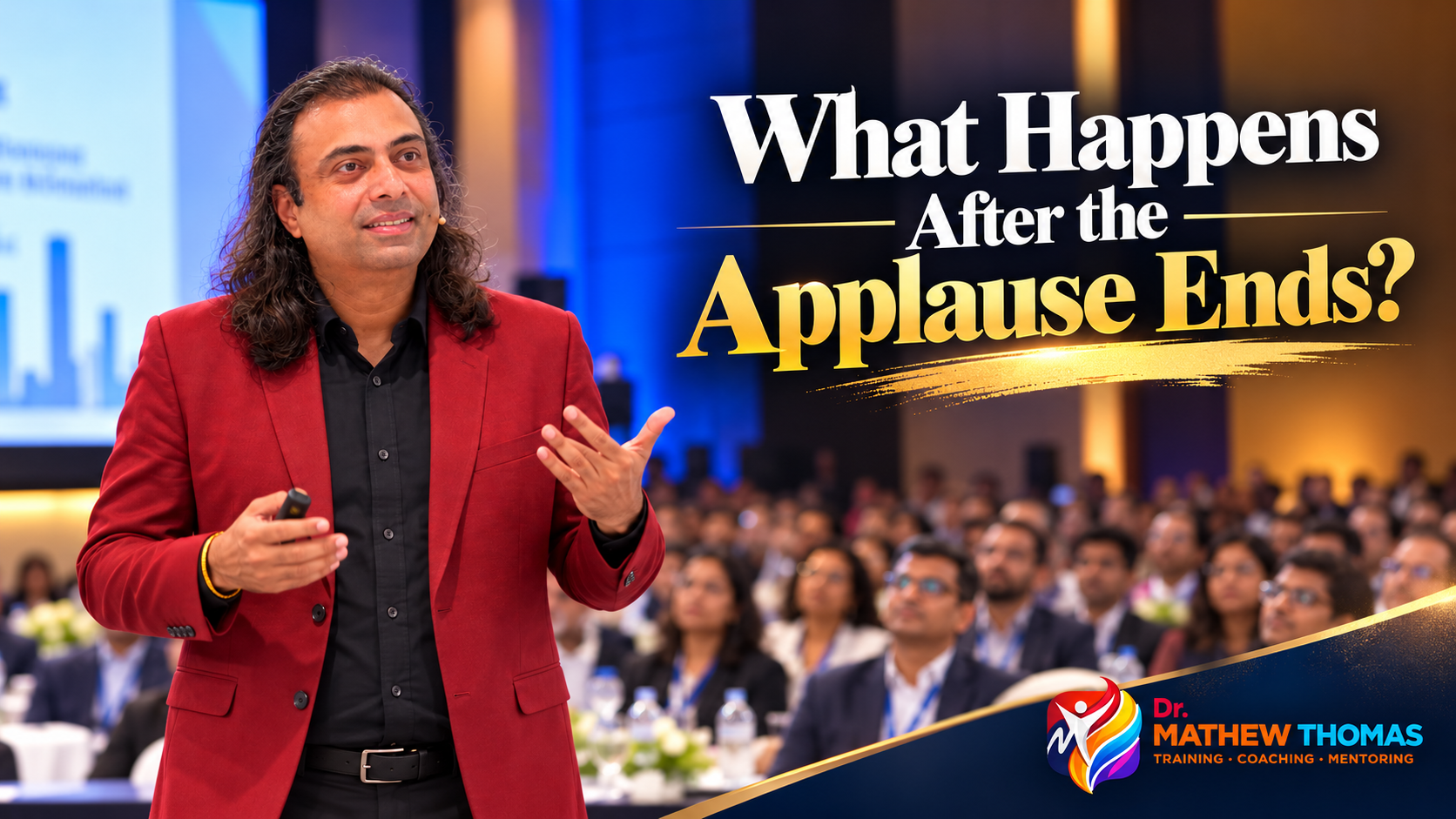

The Applause Is Not the Outcome
The auditorium is buzzing. The speaker has just finished. The final story lands perfectly. People are clapping, some are recording the last few seconds on their phones, and conversations outside the hall are full of energy. “I needed to hear this.” “From tomorrow, things are going to be different.” And perhaps, for that moment, they genuinely believe it.
Then tomorrow arrives. The emails are waiting. The targets haven’t changed. The difficult colleague is still difficult. The postponed conversation is still uncomfortable. The calendar is still packed. And within days, much of the energy created inside that auditorium has quietly disappeared.
This is one of the most important questions we need to ask about motivational speaking: what happens after the applause ends?
A Powerful Speech Can Create Emotional Momentum
Stories can make us rethink our assumptions. A compelling speaker can help an audience see possibilities they had stopped noticing. Shared energy can raise morale and reconnect people with a larger purpose. But emotional impact and behavioural change are not the same thing.
A person can leave a session deeply inspired and still return to exactly the same behaviour a week later. That does not necessarily mean the speech failed. It means we may have expected the speech to accomplish something that no single speech can realistically accomplish on its own. Inspiration can open the door. Change still requires someone to walk through it — repeatedly.
Why Inspiration Fades
Human behaviour rarely changes simply because we understand what we should do. We know we should exercise. We know leaders should listen before reacting. We know difficult conversations should not be postponed indefinitely. We know delegation is necessary. We know relationships require attention.
The problem is often not awareness. The problem is converting awareness into behaviour when familiar pressures return. After a motivational event, people go back into environments shaped by existing routines, competing priorities, workplace expectations and deeply established habits. If nothing in that environment changes, the old behaviour usually remains the easiest behaviour.
This is where workplace motivation becomes more complex than simply making people feel positive. Sustainable change needs more than emotion. It requires clarity, practice, reinforcement, accountability and personal responsibility.
Where Motivational Speaking Goes Wrong
Motivational speaking itself is not the problem. The problem begins when we confuse a motivational event with a behavioural-change process. Several things can reduce the lasting impact of a speech.
A message may be inspirational but too generic. “Believe in yourself” sounds encouraging, but what should a sales manager actually do differently at 10 a.m. on Monday? Sometimes the promise is unrealistic — deep-rooted leadership, communication or performance challenges are unlikely to disappear because employees attended one energetic session. At other times, the message is relevant but there is no practical bridge between insight and action.
And perhaps the biggest mistake is expecting the speaker to carry the entire responsibility for change. Imagine an organisation encouraging managers to become better coaches during a motivational session. Everyone agrees enthusiastically. But after the session, managers continue to be evaluated almost entirely on short-term output. Calendars leave little room for developmental conversations. Senior leaders continue solving problems for their teams rather than coaching them.
The speech says, “Coach your people.” The environment says, “Just get the job done.” Eventually, the environment usually wins.
A Better Approach to Motivation
The real question, therefore, should not be “was the audience motivated?” A better question is: “what will the audience do differently because they were motivated?” That shift changes everything.
An effective motivational speech should not merely increase energy. It should help people identify where that energy needs to go. Instead of leaving with ten memorable ideas, perhaps an individual leaves with one meaningful commitment. Instead of saying “I am going to become a better leader,” the commitment becomes: “For the next four weeks, I will conduct one 30-minute coaching conversation with each of my direct reports without taking over their problems.”
Now inspiration has somewhere to land. The objective is not to eliminate emotion from motivational speaking — emotion is often what makes a message memorable. The objective is to connect emotion to action.
Dr. Mathew Thomas’s Perspective: Inspiration Must Have a Destination
For Dr. Mathew Thomas, whose work spans leadership development, facilitation and motivational speaking, the more useful conversation around motivation is not simply about creating a powerful moment — it is about what that moment enables next.
A speaker’s influence should not be judged only by the energy in the room. The more meaningful question is whether the audience leaves with greater clarity about themselves, their choices and the actions available to them. This is particularly important in leadership development and employee engagement.
A leader may feel inspired to communicate differently. But when the next conflict arrives, can that leader pause before reacting? A manager may understand the importance of delegation. But when a deadline becomes tight, can that manager resist taking the work back? A professional may decide to become more confident. But when the next difficult meeting begins, can that person actually speak up?
These are the moments where motivation is tested. The true test of inspiration is not how strongly we feel during the speech. It is what we choose when the feeling is no longer there. A speech can ignite something. It cannot practise on your behalf.
Turning Inspiration Into Action: Five Questions
One simple way to make motivational speaking more useful is to create a bridge between the event and what happens afterward. Think of it as five questions:
- What is the ONE idea I am taking away? Not ten ideas — choose the one insight most relevant to your current reality.
- What will I DO differently? Translate the idea into an observable behaviour.
- By WHEN will I do it? Give the intention a realistic deadline.
- How will I KNOW I have acted on it? Define a simple indicator of progress.
- Who will help me stay ACCOUNTABLE? A manager, colleague, coach, friend or scheduled personal review can provide reinforcement.
Suppose a manager attends a session and realises that they interrupt people too frequently. “Listen more” is an intention. A stronger commitment might be: “During my next three team meetings, I will ask at least two questions before offering my own solution, and I will review how consistently I did this at the end of the week.”
That does not guarantee permanent behavioural change. But it turns an abstract insight into something that can actually be practised, observed and improved. Organisations can strengthen this further through manager conversations, peer accountability, reflection exercises, follow-up sessions and reinforcement through existing leadership processes. This is where a motivational speech can become the beginning of development rather than the end of an event.
Motivational Speeches Do Have a Powerful Role
None of this means motivational speeches are ineffective. Sometimes an organisation genuinely needs a shared emotional moment. A team going through uncertainty may need hope. Leaders beginning a transformation may need a compelling shared vision. Employees who have been operating under sustained pressure may benefit from reconnecting with purpose. An individual may hear one story that causes them to reconsider a choice they have been postponing for years. Those moments matter.
The mistake is not believing in the power of inspiration. The mistake is expecting inspiration to do the work of discipline, skill development, leadership support, accountability and repetition. A speech can create the spark. But sparks need something to sustain them.
What Happens After the Applause Ends?
Perhaps this is the question every speaker, HR leader and participant should ask before the event even begins. Not “how do we make this session unforgettable?” but “what should still be different 30 days after this session?”
That question changes how speakers design their message. It changes how organisations think about motivational events. And it changes how individuals participate in them. Instead of consuming inspiration, we begin converting it into responsibility.
Because ultimately, the most powerful motivational speech is not necessarily the one that receives the loudest applause. It is the one that leaves behind an idea strong enough to survive a difficult Monday morning. Applause tells you the message was heard. Action tells you the message mattered.
Frequently Asked Questions
1. Why does motivation from a speech fade so quickly?
Because awareness of what to do is not the same as behaviour change. Once people return to familiar environments, routines and pressures, old behaviour remains the easiest option unless something in the environment or follow-through also changes.
2. Does this mean motivational speeches don’t work?
No. Motivational speeches can create real emotional momentum, shared purpose and a powerful shared moment. The mistake is expecting the speech alone to produce lasting behavioural change without follow-up action, accountability and reinforcement.
3. How can organisations make motivational sessions more effective?
By pairing the session with a simple commitment framework (one idea, one action, a deadline, a way to measure it, and an accountability partner), and by following up with structured leadership training or coaching that reinforces the message over time.
4. What is the difference between motivational speaking and leadership training?
Motivational speaking builds belief and energy, usually in a single session. Leadership training builds capability through structured, interactive learning over time. The two work best together — a keynote can introduce a theme that training and coaching then help people practise.
Closing Thought
What happens after the applause ends may be the most important part of motivational speaking. Dr. Mathew Thomas is a Mumbai-based motivational speaker and leadership trainer who designs keynotes and workshops around exactly this principle — turning inspiration into a plan people can actually follow through on. Explore his leadership training programmes, visit the home page, or find Mentora India on Google Maps.