


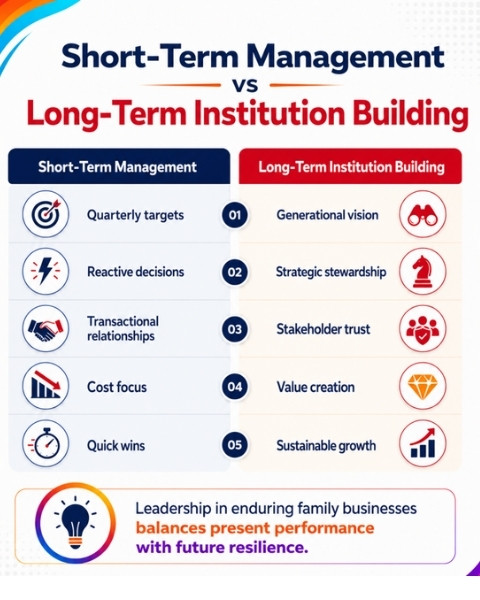
 One of the most powerful leadership lessons from Indian family businesses is the ability to think across generations. Many family enterprises do not measure success only by quarterly performance. They ask deeper questions: Will this decision protect the reputation of the business? Will it strengthen the next generation? Will it preserve stakeholder trust?
McKinsey’s research on outperforming family-owned businesses shows that long-term perspective, reinvestment in the business and financial discipline are key differentiators. This explains why many family businesses are able to endure market cycles, economic shocks and industry disruption.
For modern leaders, the lesson is clear. Sustainable leadership requires more than speed. It requires stewardship. Leaders must learn to balance immediate performance with long-term resilience.
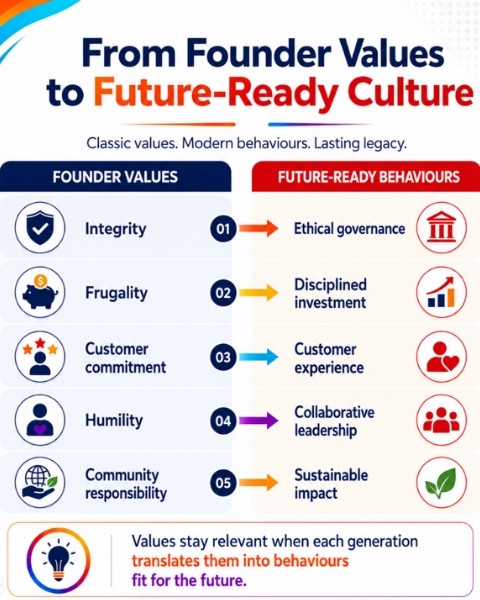 Many Indian family businesses are anchored in founder values such as integrity, frugality, humility, customer commitment, social responsibility and hard work. These values often become the moral operating system of the enterprise.
However, every generation must reinterpret values for a new context. Frugality should not become underinvestment. Respect for elders should not prevent honest dialogue. Loyalty should not become tolerance of poor performance. Tradition should not become resistance to innovation.
For example, several long-standing Indian business groups have successfully modernised while retaining their values. The Tata Group is often associated with trust, nation-building and ethical business. Mahindra has built a leadership identity around purpose, innovation and global ambition. Godrej has combined heritage with professional management, sustainability and brand reinvention.
The lesson is that values must be lived, not laminated. They must guide real decisions in hiring, governance, customer service, innovation and conflict resolution.
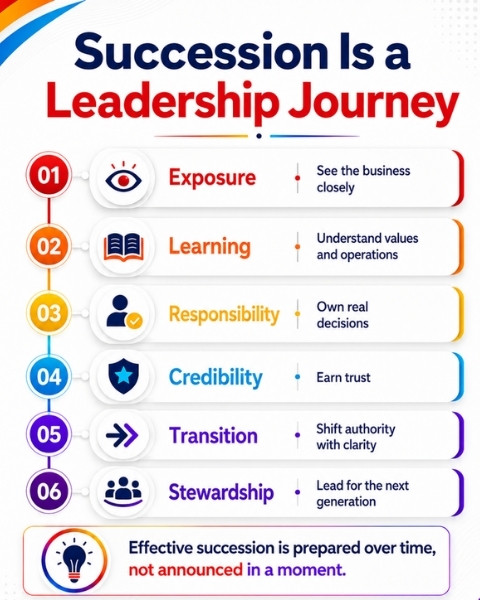 Succession is one of the most sensitive challenges in Indian family businesses. It is not simply about transferring ownership or appointing the next managing director. It is about transferring trust, credibility, judgement and responsibility.
A successor may inherit a surname but must earn leadership legitimacy. Employees watch whether the next-generation leader understands the business. Professionals observe whether decisions are merit-based. Family members evaluate fairness. Customers and partners assess continuity.
Strong succession requires early exposure, mentoring, external experience, structured roles, leadership coaching and clear governance. Without these, succession can become emotional, political and disruptive.
This is where experienced facilitation becomes valuable. Families often need neutral spaces for difficult conversations around roles, authority, expectations, ownership and future direction. A leadership transition is not only a business event. It is also an emotional and relational transition.
For all organizations, the message is the same: leadership pipelines must be developed deliberately. Future leaders are built through experience, feedback and accountability.
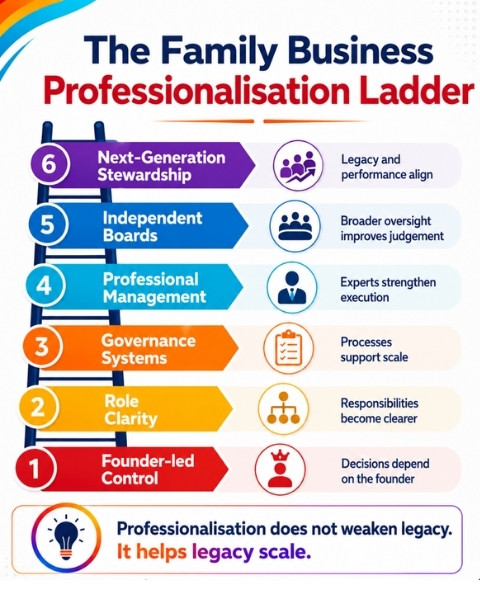 A common fear in family businesses is that professionalisation may dilute family control. In reality, professionalisation strengthens legacy when done well.
Professionalisation means creating systems that allow the business to grow beyond individual personalities. It includes role clarity, independent advice, performance metrics, governance forums, transparent decision-making and the integration of professional talent.
India’s strongest family enterprises have recognised this. The most successful groups often combine family ownership with professional leadership, structured boards and disciplined management practices. This allows the family to focus on vision, values and long-term stewardship while professionals bring scale, expertise and execution rigour.
The leadership lesson is simple: charisma may build a business but systems sustain it. Leaders who want enduring impact must design organizations that do not depend only on them.
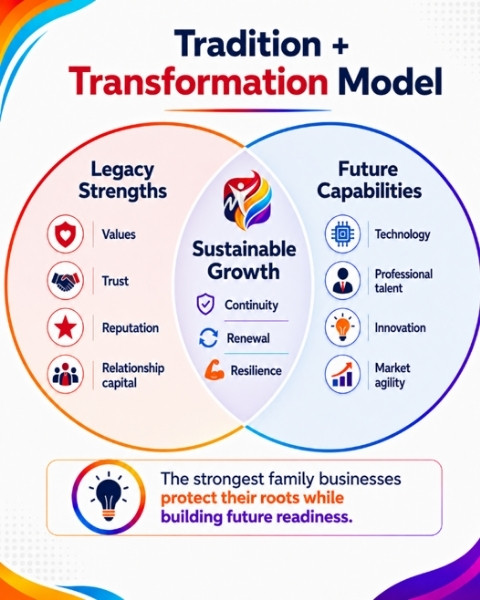 Legacy is a strength only when it remains relevant. Indian family businesses that continue to thrive are those that respect tradition while embracing change. They invest in technology, new markets, professional talent, digital transformation and customer insight.
PwC India’s Family Business Survey 2023 found that 68% of respondents identified expansion into new markets as a top priority. Deloitte’s 2025 insights also pointed to increasing AI adoption among Indian family businesses, showing that legacy enterprises are not standing still.
The key leadership question is not “Should we preserve tradition or pursue transformation?” The better question is “How do we transform in a way that protects what is most valuable?”
This requires maturity. Senior leaders must allow the next generation to challenge old assumptions. Younger leaders must honour the wisdom that built the business. Transformation succeeds when it is framed not as rebellion but as renewal.