
How Leaders Should Communicate in a Crisis

How Leaders Should Communicate in a Crisis

You are currently viewing How Leaders Should Communicate in a Crisis

How Leaders Should Communicate in a Crisis

How Leaders Should Communicate in a Crisis: Calm, Clarity and Trust in Uncertain Times

A crisis does not simply test strategy. It tests the voice of leadership. When uncertainty rises, people do not only look for decisions. They look for signals. They observe the leader’s tone, body language, timing, confidence, honesty and emotional steadiness.

This is why leadership communication during crisis is different from routine communication. In normal times, communication informs. In crisis, communication stabilizes.

Dr. Mathew’s perspective on leadership communication is rooted in a simple but powerful idea: in a crisis, people need more than updates. They need calm, clarity, empathy and direction. Whether the situation involves layoffs, business disruption, conflict, safety concerns, market uncertainty, public criticism or organizational change, the leader’s words can either reduce fear or multiply confusion.

The real question is not, “How do we issue a crisis statement?” The better question is, “How should a leader communicate when people are anxious, uncertain or afraid?”

Why Communication Matters More During a Crisis

During a crisis, people naturally search for answers:

  • Are we safe?
  • Does leadership know what is happening?
  • Can I trust what I am being told?
  • What should I do now?
  • Will this affect my future?

If leaders are silent, people create their own stories. If leaders sound defensive, trust drops. If leaders overpromise, credibility suffers. If leaders communicate with calm honesty, people are more likely to stay focused, cooperative and resilient.

Research on crisis and emergency risk communication consistently emphasizes the importance of being timely, accurate, credible, empathetic and action-oriented. Leadership research also highlights the value of deliberate calm, bounded optimism, transparency and empathy during uncertainty.

For Dr. Mathew, this means crisis leadership communication is not about sounding impressive. It is about helping people move from fear to focused action.

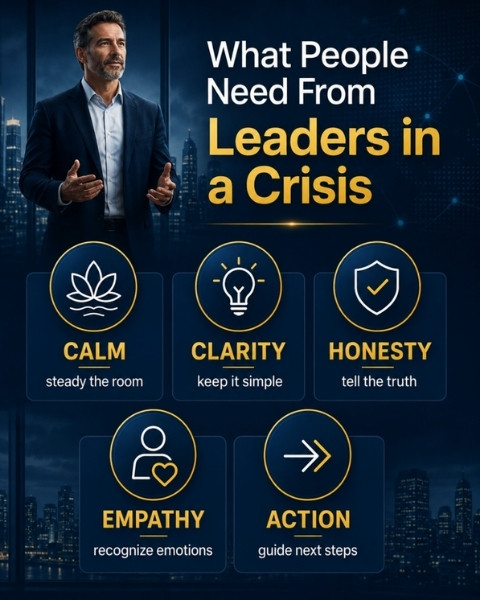
The Five Things People Need From Leaders in a Crisis

  1. The Five Things People Need From Leaders in a CrisisCalm

The first responsibility of a leader is emotional containment. A leader who speaks with panic spreads panic. A leader who speaks with calm creates space for better thinking.

Calm does not mean minimizing the crisis. It means showing that the situation is serious but manageable. Leaders must regulate themselves before they try to regulate the room.

A calm leader says: “This is difficult, but we are not helpless. We will address this step by step.”

  1. Clarity

In crisis, people cannot process complicated language. They need simple, direct and repeated messages.

Leaders should avoid vague phrases such as “We are looking into various strategic possibilities” and instead say, “Here is what we know, here is what we are checking and here is what happens next.”

Clarity reduces anxiety because it gives people mental structure.

  1. Honesty

One of the biggest mistakes leaders make during crisis is pretending to know more than they do. People do not expect leaders to have every answer immediately. They do expect leaders to be truthful.

Honesty sounds like this: “We do not have all the answers yet. We are verifying the facts and will update you by 5 PM.”

This builds more trust than false certainty.

  1. Empathy

People listen better when they feel seen. Before giving instructions, leaders should acknowledge the human impact of the crisis.

Empathy is not emotional weakness. It is leadership intelligence.

A leader may say: “I understand this news may create anxiety for many of you. That is understandable. We will make sure you are not left in the dark.”

  1. Action

Every crisis message must move people toward the next right action. Without action, communication becomes emotional noise.

Leaders should answer: What should people do now? Who is responsible? When will the next update come? Where can they ask questions?
The C.A.L.M. Framework for Leadership Communication in Crisis

The C.A.L.M. Framework for Leadership Communication in Crisis

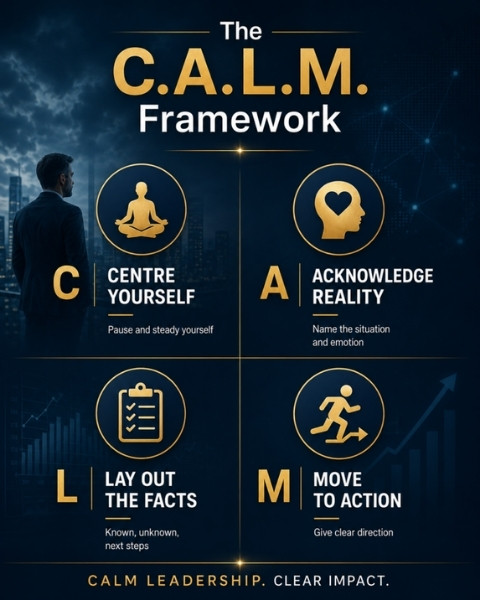
Dr. Mathew’s practical framework for crisis leadership communication can be summarized as C.A.L.M.

C — Centre Yourself Before You Speak

Before addressing others, leaders must pause, breathe, gather facts and check their emotional state. In crisis, the leader’s nervous system enters the room before the leader’s words do.

Centred communication prevents reactive statements, blame and unnecessary fear.

A — Acknowledge Reality and Emotion

Do not begin with corporate language. Begin with reality. Name what has happened and acknowledge what people may be feeling.

Example: “We are facing a serious disruption and I know this is creating concern across the team.”

This tells people that leadership is not avoiding the truth.

L — Lay Out What Is Known, Unknown and Being Done

Separate facts from assumptions. This is one of the most important credibility tools in crisis leadership.

A strong structure is:

  • What we know
  • What we do not know yet
  • What we are doing now
  • When we will update you again

This simple structure helps people trust the process even when outcomes are uncertain.

M — Move People to the Next Action

End every message with direction. Crisis communication should not leave people emotionally stirred but practically unclear.

Example: “For now, please continue operations as planned. Team leads will receive detailed instructions within the next hour.”

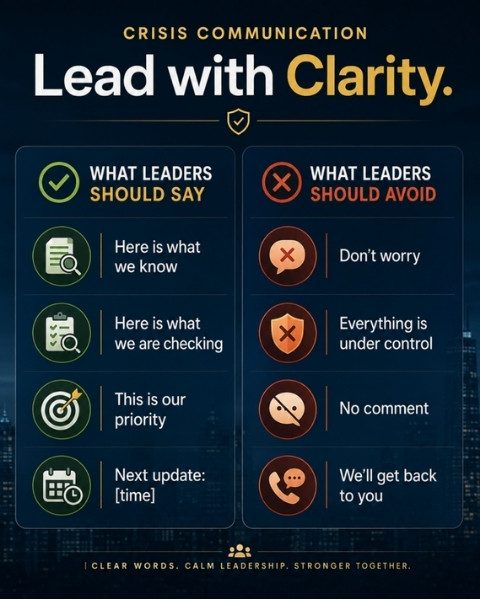
What Leaders Should Say During a Crisis

What Leaders Should Say During a Crisis

Leaders do not need dramatic speeches. They need human, clear and responsible language.

Useful phrases include:

  • “Here is what we know at this point.”
  • “Here is what we are still verifying.”
  • “Our immediate priority is people, safety and continuity.”
  • “I understand the concern this may create.”
  • “We will not speculate, but we will keep you informed.”
  • “The next update will come by this time.”
  • “Your questions are valid and we will address them as clearly as possible.”

The best crisis language is short, honest and repeatable.

What Leaders Should Avoid Saying

Certain phrases can damage trust quickly. Leaders should avoid:

  • “Don’t worry” when people are clearly worried
  • “Everything is under control” when the facts are incomplete
  • “No comment” without explanation
  • “This is not a big issue” before impact is known
  • Blaming others too early
  • Using legalistic or robotic language
  • Making promises that may not hold
  • Disappearing after the first message

In a crisis, people remember not only what leaders said but how those words made them feel.

Tools Leaders Can Use for Better Crisis Communication

  1. The Three-Message Rule

Every leader should prepare three key messages:

  1. What happened?
  2. What are we doing?
  3. What should people do next?

This prevents rambling and keeps communication focused.

  1. The Stakeholder Lens

Different groups need different emphasis.

Employees need security, direction and honesty.
Customers need impact, timelines and support.
Senior leaders need decisions, risks and responsibilities.
External stakeholders need accountability and confidence.

The message should be consistent but not identical for every audience.

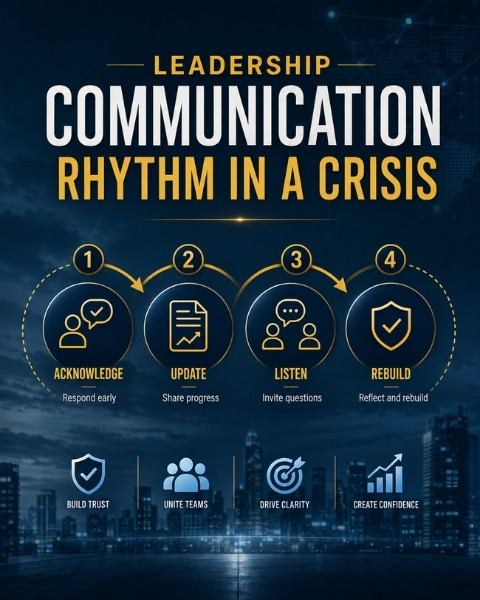
  1. The Update Rhythm

A crisis needs a communication rhythm. Silence creates speculation.

Leaders should set predictable updates: hourly, daily or weekly depending on the seriousness of the situation.

Even a short update saying “We are still working on this and will update you again at 4 PM” is better than silence.

  1. The Question Log

Leaders should collect repeated questions from employees, customers and teams. These questions reveal fear points. Addressing them directly improves trust and reduces rumours.

  1. The After-Action Reflection

After the crisis, leaders should ask:

  • What did people need that we did not provide?
  • Where did confusion increase?
  • Which messages built trust?
  • What should we change next time?

This converts crisis experience into leadership capability.

A Step-by-Step Program for Leaders Communicating in Crisis

Step 1: Pause before speaking

Do not communicate from panic. Gather the minimum facts needed to speak responsibly.

Step 2: Identify who needs to hear from you first

In many crises, employees should hear from leadership before the public or external stakeholders.

Step 3: Acknowledge the situation early

You do not need all answers to acknowledge reality. Early acknowledgement reduces uncertainty.

Step 4: Use the C.A.L.M. framework

Centre yourself, acknowledge reality, lay out facts and move people to action.

Step 5: Repeat the core message

In uncertainty, people need repetition. Say the important things more than once.

Step 6: Create two-way communication

Allow questions. Listening is part of leading. People trust leaders who hear concerns instead of only broadcasting instructions.

Step 7: Close the loop after the crisis

When the situation stabilizes, explain what happened, what was learned and what will change. This is essential for rebuilding confidence.

Conclusion: In Crisis, the Leader’s Voice Becomes the Anchor

Crisis does not demand perfect communication. It demands responsible communication.

People do not expect leaders to remove uncertainty instantly. They expect leaders to stand in uncertainty with courage, honesty and steadiness. The leader’s voice becomes the anchor when everything else feels unstable.

Dr. Mathew’s leadership insight is clear: in a crisis, communication is not about control. It is about trust. Leaders who speak with calm, clarity, empathy and action help people think better, respond better and recover stronger.

When leaders communicate well in crisis, they do more than manage a difficult moment. They build the credibility that people remember long after the crisis has passed.

Frequently Asked Questions

1. How should a leader communicate during a crisis?

A leader should communicate with calm, clarity, honesty, empathy and direction. People need to know what happened, what is being done and what they should do next.

The first message should acknowledge the situation, show concern, state immediate priorities and promise the next update. Leaders should avoid speculation.

Leaders stay calm by pausing before responding, gathering facts, regulating their emotions and focusing on the next responsible action instead of the entire uncertainty.

Trust is built through honesty, consistency, empathy and visible action. Leaders should say what they know, admit what they do not know and keep updating people.

Leaders should communicate as often as people need clarity. In fast-moving crises, updates may be frequent. In slower crises, a predictable daily or weekly rhythm may work.

Empathy helps people feel seen and respected. It reduces emotional resistance and makes people more willing to listen, cooperate and act.

Leaders should avoid silence, defensiveness, vague language, false certainty, blame, jargon and overpromising.

The C.A.L.M. framework is practical for leaders: Centre yourself, Acknowledge reality, Lay out what is known and Move people to action.

— Dr. Mathew Thomas
Leadership Coach | Certified International Master Mentor