

Storytelling as a Leadership Influencing Tool: How Leaders Inspire Action Through Stories
In every boardroom, strategy meeting or town hall, leaders face the same challenge: how do you make people care enough to act?
Facts may inform people. Data may convince them. But stories move them.
A leader can present a five-year growth plan with charts, numbers and projections. Yet what often stays with the audience is not the spreadsheet. It is the story of a customer whose life changed, a team that overcame impossible odds or a defining moment that revealed why the mission matters.
This is the power of leadership storytelling. It transforms communication from instruction into influence. It helps leaders build trust, simplify complexity, create emotional connection and inspire people to move in a shared direction.
For business leaders, aspiring leaders, marketing professionals and executives, storytelling is no longer a soft skill. It is a strategic communication skill. In a world where attention is limited and trust is hard-earned, the ability to use stories well can become a powerful leadership advantage.
Leadership is not only about making decisions. It is about helping others understand why those decisions matter.
Many leaders struggle because they communicate only through information. They explain targets, processes, market realities and business priorities. While these are important, information alone rarely creates deep commitment.
Stories work because they engage both logic and emotion. They help people see meaning behind action. They make abstract ideas human, memorable and easier to repeat.
A strong leadership story can:
- Build trust by showing authenticity
- Create emotional connection with teams
- Simplify complex ideas
- Make vision easier to understand
- Inspire people during change
- Strengthen alignment across teams
- Influence stakeholders without pressure
When leaders tell stories with clarity and purpose, they do more than communicate. They create belief.
The Psychology Behind Influence Through Stories
Human beings are wired for stories. Long before formal presentations, reports or management frameworks existed, people used stories to pass on values, warnings, identity and wisdom.
In leadership communication, stories work because they create three powerful effects.
1. Stories Make Ideas Memorable
People forget data quickly when it is presented without context. A story gives information a structure. It has a beginning, challenge, turning point and outcome. This makes the message easier to remember and share.
For example, instead of saying, “Customer responsiveness is important,” a leader can share a short story about a customer who nearly left the company until one employee took ownership and solved the issue. The value becomes real.
2. Stories Build Emotional Buy-In
People may understand a decision intellectually but still resist it emotionally. Stories help bridge that gap.
During change, uncertainty or transformation, employees often ask silent questions: Why now? Why should I trust this? What does this mean for me?
A well-chosen story can answer these questions with empathy. It allows leaders to acknowledge fear, show possibility and build confidence.
3. Stories Create Shared Meaning
Organizations do not run only on policies. They run on shared meaning. People need to know what the company stands for, what behaviours matter and what kind of future they are building together.
Stories help leaders turn values into lived examples. They show what courage, ownership, innovation or collaboration looks like in practice.
This is where Dr. Mathew Thomas’s leadership approach becomes relevant. Effective leadership storytelling is not performance. It is not about dramatic speechmaking. It is about helping leaders communicate meaning with authenticity, structure and influence.
Leadership Storytelling Is Not Entertainment
One common misunderstanding is that storytelling means adding humour, drama or personal anecdotes to every presentation. That is not leadership storytelling.
Leadership storytelling is purposeful communication.
It asks:
- What message must be remembered?
- Who needs to be influenced?
- What belief or behaviour must shift?
- Which story will make the message real?
- How can the story be told with honesty and relevance?
A story without purpose can distract. A story with purpose can transform the way people think, feel and act.
For leaders, the goal is not to become entertainers. The goal is to become clearer, more credible and more influential communicators.
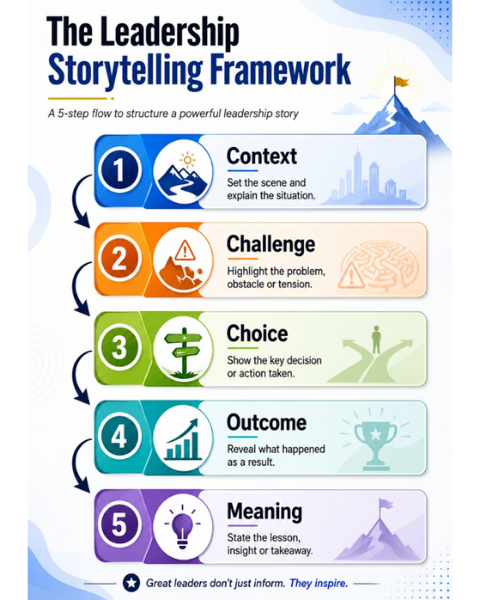
A powerful leadership story does not need to be long. In fact, many of the best leadership stories are brief. What matters is structure.
- Context
Set the scene. Help people understand where the story begins.
Example: “When our team entered a new market last year, we had no brand recognition and limited resources.”
- Challenge
Every meaningful story needs tension. What problem, obstacle or uncertainty had to be faced?
Example: “The first three client meetings ended in rejection. The team began questioning whether the strategy would work.”
- Choice
This is where leadership appears. What decision, behaviour or mindset made the difference?
Example: “Instead of changing the strategy immediately, the team listened more deeply to customer concerns and redesigned the pitch.”
- Outcome
Show what changed because of the choice.
Example: “Within three months, the same team converted two major clients and built a repeatable market entry playbook.”
- Meaning
This is the leadership lesson. Without meaning, a story remains an incident.
Example: “The lesson is simple: when the market resists us, we must not only sell harder. We must listen better.”
This structure turns experience into insight. It helps leaders influence without sounding forceful.
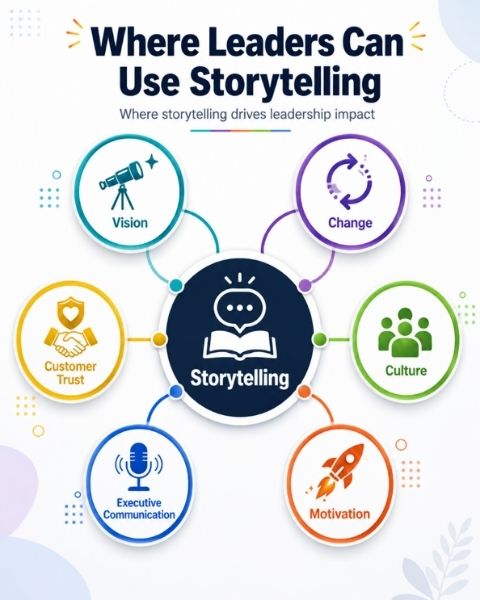
Where Leaders Can Use Storytelling
Leadership storytelling is useful across many business situations. It is especially powerful when leaders need to influence belief, behaviour or direction.
Vision Communication
A vision statement can sound abstract. A story makes it tangible.
Instead of saying, “We aim to become the most trusted partner in our industry,” a leader can share a story that shows what trust looks like in a real client relationship.
Change Management
Change often creates resistance. Stories help people understand why change is necessary and what future success can look like.
A leader may share a story about a previous transformation, the discomfort it created and the growth that followed.
Team Motivation
When teams feel tired or disconnected, stories can remind them of their purpose.
A story about a customer impact, a team win or a moment of resilience can restore energy and pride.
Executive Communication
Senior leaders must often influence boards, investors, clients and cross-functional teams. A clear business narrative can connect strategy, risk, opportunity and action.
This is especially important in executive communication skills, where clarity and confidence must work together.
Culture Building
Culture is shaped by the stories people repeat. Leaders who intentionally tell stories about desired behaviours help define what the organization values.
If leaders want ownership, they must tell stories of ownership. If they want innovation, they must tell stories of intelligent risk-taking.
Business Narrative Strategies Leaders Can Apply Immediately
Storytelling becomes effective when it is practised intentionally. Here are practical strategies leaders can begin using right away.
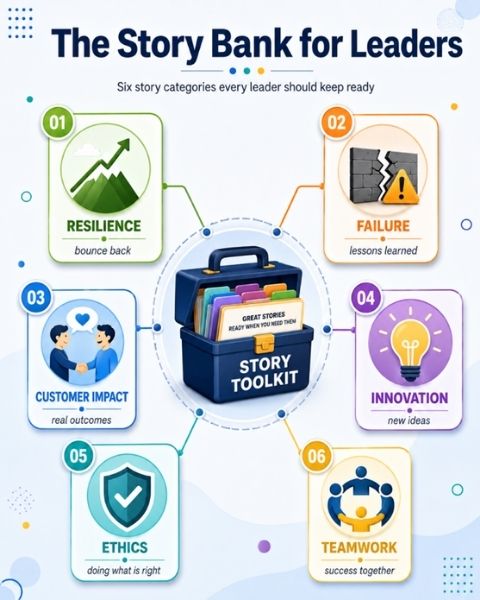
- Build a Personal Story Bank
Leaders should maintain a collection of short stories from their own experience, customer interactions, team moments, failures, turning points and lessons learned.
Useful categories include:
- A story about resilience
- A story about customer focus
- A story about ethical decision-making
- A story about learning from failure
- A story about collaboration
- A story about leading through uncertainty
This story bank becomes a resource for speeches, meetings, coaching conversations and presentations.
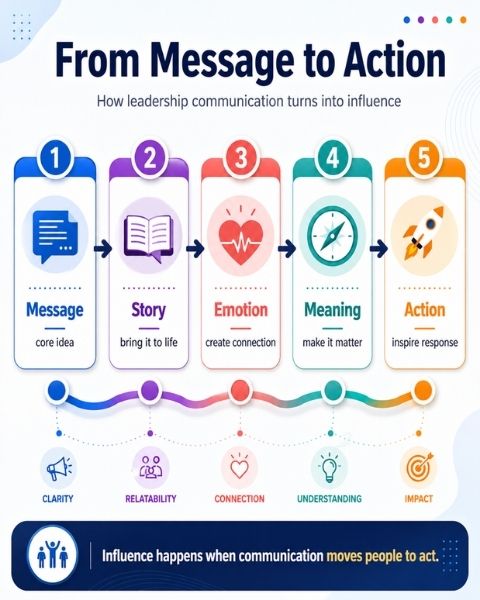
- Start With the Message, Not the Story
Many leaders make the mistake of choosing a story first. Instead, begin with the message.
Ask: What do I want people to remember?
Once the message is clear, choose a story that supports it. This keeps communication focused and prevents unnecessary storytelling.
- Use Specific Details
Generic stories do not create impact. Specific details make stories believable.
Instead of saying, “A customer was unhappy,” say, “A long-standing client called us two days before renewal and said they were considering leaving.”
Specificity creates emotional realism.
- Keep It Brief
A leadership story should support the message, not dominate the conversation. In most business settings, a story between 60 seconds and three minutes is enough.
The aim is clarity, not length.
- Connect the Story to Action
Every leadership story should lead somewhere.
After telling the story, connect it to a clear action:
- “This is why we must listen before we respond.”
- “This is why the next quarter matters.”
- “This is why collaboration across teams is no longer optional.”
- “This is why I am asking each of you to take ownership.”
Influence happens when story becomes direction.
The Transformational Impact of Leadership Storytelling
When leaders master storytelling, communication changes at every level.
Teams begin to understand strategy more clearly. Employees feel connected to a larger purpose. Stakeholders see not just what the organization does but why it matters. Leaders become more relatable, trustworthy and memorable.
In many organizations, the gap is not a lack of strategy. It is a lack of narrative. People may know the plan but not feel connected to it. They may hear the goals but not understand the meaning behind them.
This is where leadership storytelling creates transformation.
Dr. Mathew Thomas’s perspective on leadership communication emphasizes that influence is not built by authority alone. It is built through clarity, credibility and connection. Storytelling brings these three together. It allows leaders to communicate with both strategic depth and human relevance.
For Indian business leaders and global executives alike, this skill is becoming increasingly important. Teams are more diverse. Workplaces are more hybrid. Attention spans are shorter. Trust must be built across distance, difference and constant change.
The leaders who stand out are not only those who know what to say. They are those who know how to make people feel the importance of what is being said.
Action: How to Begin Your Leadership Storytelling Practice
Leadership storytelling can be learned. It does not require theatrical talent. It requires reflection, structure and practice.
Begin with these steps:
- Identify one leadership message you repeat often
- Choose one real experience that illustrates that message
- Structure it with context, challenge, choice, outcome and meaning
- Practise telling it in under two minutes
- Use it in your next meeting, presentation or coaching conversation
- Observe how people respond
- Refine it for clarity and emotional impact
The more leaders practise, the more natural storytelling becomes.
In the end, storytelling is not about speaking beautifully. It is about helping people see clearly, care deeply and act confidently.
For leaders who want to strengthen their influence, inspire teams and communicate with greater impact, storytelling is one of the most powerful tools available.
To explore more insights on leadership storytelling, executive communication and influence through stories, visit Dr. Mathew Thomas’s website and discover how strategic storytelling can help leaders communicate with clarity, confidence and lasting impact.
— Dr. Mathew Thomas
Leadership Coach | Certified International Master Mentor
