


Why First-Time Managers Fail

Why First-Time Managers Fail

You are currently viewing Why First-Time Managers Fail

Why First-Time Managers Fail

The Leadership Gap No One Talks About Enough

The first promotion into management is often seen as a reward for performance. A high-performing employee delivers results, earns trust and is promoted to lead others. Yet this is precisely where many organizations make a costly mistake. Being excellent at doing the work is not the same as being prepared to get work done through people.

In my experience as a leadership facilitator, motivational speaker and advisor to growing organizations, I have seen many first-time managers struggle not because they lack intelligence or commitment but because they are promoted into a role for which they were never truly prepared. The transition from individual contributor to manager is not a simple career step. It is an identity shift.

Research from leadership organizations such as Gallup, Gartner, Harvard Business Review and DDI repeatedly points to the same issue: new managers often fail because organizations underestimate the emotional, relational and strategic demands of management. They are expected to coach, communicate, delegate, resolve conflict, motivate teams and deliver performance without enough training or support.

So why do first-time managers fail? Let us examine the real reasons and what can be done to help new managers succeed.

Why Do First-Time Managers Fail?

Why New managers Feel unpreparedFirst-time managers fail because they continue behaving like top individual performers instead of learning how to lead through others. They often enter the role with technical credibility but limited leadership capability. They know the work, but they may not yet know how to build trust, give feedback, manage conflict or create accountability.

Many new managers also face what I call the “silent expectation trap.” Everyone assumes they should automatically know how to manage because they were good at their previous role. Their team expects confidence. Senior leaders expect results. The new manager feels pressure to prove the promotion was deserved.

This pressure creates predictable first-time manager struggles such as micromanagement, poor delegation, avoidance of difficult conversations and overdependence on personal effort.

The Most Common Mistakes New Managers Make

1. They try to remain the best performer on the team

From Individual Contributor to LeaderOne of the biggest mistakes new managers make is trying to remain the most productive person in the room. They still want to solve every problem, review every detail and rescue every deadline.

This approach may feel responsible, but it prevents the team from growing. A manager’s success is no longer measured only by personal output. It is measured by the capability, confidence and performance of the team.

A first-time manager must learn that leadership is not about being indispensable. It is about making others more capable.

2. They micromanage because they fear failure

The Micromanagement TrapMicromanagement is one of the most searched and discussed new manager mistakes for a reason. First-time managers often micromanage because they are anxious. They fear missed deadlines, poor quality and judgment from senior leaders.

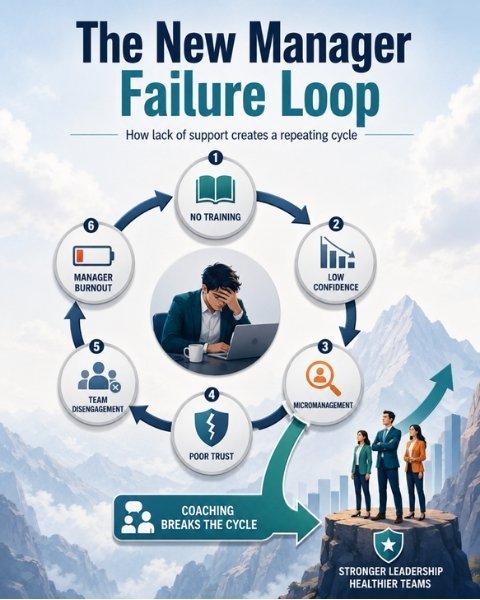
The micromanagement trap begins with good intentions but ends in low trust. Employees feel watched rather than supported. Creativity drops. Ownership weakens. The manager becomes exhausted because every decision flows back to them.

Effective leadership requires clarity without control. New managers must define outcomes, agree on standards and create checkpoints without taking over the work.
3. They fail to delegate effectively

Delegation is not simply assigning tasks. It is the art of matching responsibility with capability, clarity and trust.

Many first-time managers fail because they either delegate too little or delegate poorly. Some keep important work with themselves because they believe it is faster. Others hand over tasks without explaining context, expectations or decision rights.

Successful delegation answers four questions clearly: What needs to be done? Why does it matter? What does good look like? When should we review progress?

When these questions are unanswered, delegation becomes confusion. When they are answered well, delegation becomes development.

4. They avoid difficult conversations

One of the biggest challenges for a new manager is handling conflict. This is especially true when managing former peers or older, more experienced team members.

Many first-time managers delay feedback because they want to be liked. They soften performance issues, tolerate poor behaviour or hope problems will resolve themselves. Unfortunately, avoided conversations usually become bigger problems.

Leadership requires respectful honesty. Feedback should not be an emotional confrontation. It should be a clear discussion about expectations, impact and improvement. The best new managers learn to address issues early, directly and with dignity.

A title gives a manager positional authority, but it does not automatically create influence. Some new managers overuse authority because they are unsure how else to lead. Others underuse authority because they fear being seen as bossy.

Both extremes create problems.

Authority leadership says, “Do this because I said so.” Effective leadership says, “Here is the purpose, here is the standard and here is how we will succeed together.”

In my leadership sessions, I often remind managers that trust is the real operating system of leadership. Without trust, authority becomes enforcement. With trust, authority becomes alignment.

6. They do not build psychological safety

A new manager may focus heavily on tasks and deadlines while ignoring team climate. Yet people perform better when they feel safe to ask questions, admit mistakes and share concerns.

Psychological safety does not mean avoiding accountability. It means creating an environment where people can speak honestly without fear of humiliation. First-time managers who dismiss questions, react defensively or punish mistakes soon create silence.

And silence is dangerous. It hides problems until they become crises.

7. They underestimate communication

Poor communication is one of the most common reasons new managers fail. First-time managers often assume that because something was said once, it was understood. But teams need repetition, context and clarity.

A manager must communicate priorities, decisions, roles, deadlines and changes consistently. In hybrid and fast-moving workplaces, silence is quickly filled by assumptions.

A simple communication rhythm can help: weekly priorities, one-on-one conversations, feedback loops and clear follow-ups after meetings. Communication is not extra work. It is management work.

What Is the Biggest Challenge for a New Manager?

The biggest challenge for a new manager is shifting from self-performance to team performance.

This shift affects everything. Time management changes. Relationships change. Success metrics change. The manager can no longer rely only on expertise. They must learn coaching, decision-making, emotional intelligence, conflict management and strategic thinking.

This is why first-time manager training is not optional. Organizations that expect new managers to “learn on the job” often pay the price through disengagement, attrition, rework and poor team morale.

How Can a New Manager Succeed?

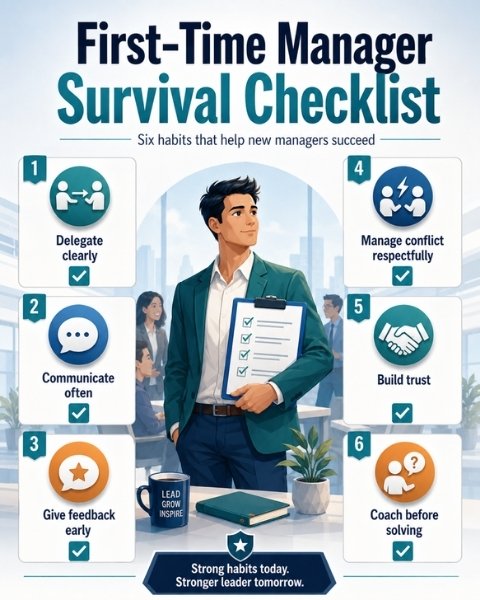
First-Time Manager Survival ChecklistA new manager can succeed by developing three core habits.

First, build trust before demanding performance. Get to know the team’s strengths, frustrations and aspirations. Listen before changing everything.

Second, clarify expectations early. People need to know what matters, how success will be measured and where decisions sit.

Third, develop a coaching mindset. Instead of giving every answer, ask better questions. Help team members think, decide and grow.

For organizations, the solution is equally clear. Do not promote people into management and leave them alone. Provide structured first-time manager training, mentoring, feedback and access to leadership coaching. A new manager should not have to choose between pretending confidence and admitting confusion.
Conclusion

The New Manager Failure LoopFirst-time managers do not fail because they are incapable. They fail because the transition into management is often treated as a promotion when it is actually a profession.

The first management role shapes how a leader thinks about power, people, performance and responsibility. If the foundation is weak, the consequences can follow a person for years. But when new managers are trained, coached and supported, they become powerful multipliers of talent.

For business leaders, HR professionals and entrepreneurs, the message is simple: do not leave first-time management success to chance. Build the leadership bridge before asking people to cross it.

As I have seen repeatedly in my work with leaders and organizations, first-time managers thrive when they are given clarity, capability and confidence. The future of leadership often begins with the first team someone is trusted to lead.

Frequently Asked Questions

Why do first-time managers fail?

First-time managers fail because they are often promoted for technical performance rather than leadership readiness. They struggle with delegation, communication, conflict management, coaching and the shift from personal success to team success.

First-time managers fail because they are often promoted for technical performance rather than leadership readiness. They struggle with delegation, communication, conflict management, coaching and the shift from personal success to team success.

The biggest challenge is shifting from doing the work personally to achieving results through others. This requires a new mindset, new skills and a stronger focus on people.

A new manager can succeed by building trust, setting clear expectations, delegating effectively, communicating consistently, asking for feedback and developing a coaching approach to leadership.

First-time manager training is important because management requires skills that are rarely developed in individual contributor roles. Training helps new managers lead with confidence, reduce mistakes and improve team performance.

There is no fixed timeline, but most new managers need consistent learning, practice and feedback over their first 12 to 18 months. Leadership capability develops through experience supported by reflection and coaching.